


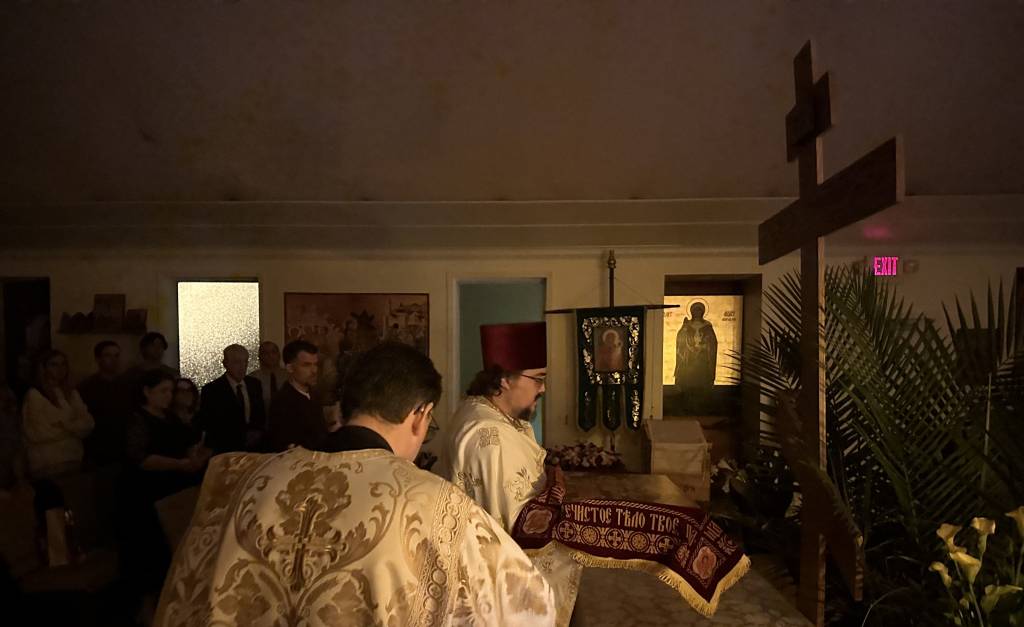
On Holy Friday in the Orthodox Church, the faithful keep watch at the tomb of Christ. This is often called Tomb Watching, and it takes place after the burial service when the holy shroud of Christ is placed in the center of the church for veneration. Orthodox Christians believe this is not just a custom or a scheduling need. It is a small but real act of love, reverence, and watchfulness before the Lord who suffered, died, and was laid in the tomb for our salvation.
Many people first hear about Tomb Watching and wonder why it matters. They may think it is simply symbolic, or just something a few very devout people do. But the Orthodox Church teaches that how we pray with our bodies shapes what happens in our souls. When we stand watch by Christ’s tomb, we are not pretending. We are entering more deeply into the mystery of His saving Passion and learning how to stay with Him in love.
Holy Friday is one of the most solemn and beautiful days in Orthodox Christianity. We remember the Lord’s crucifixion, His death in the flesh, and His burial. The One through whom all things were made allows Himself to be laid in a tomb. As the services of Holy Week show us, this is not defeat but the beginning of victory, because Christ enters death in order to destroy death from within. If you would like to take part in Tomb Watching this Holy Friday, you can sign up here: https://savannahorthodox.com/events/tomb-watch-2026/.
Why Orthodox Christians Keep Watch at Christ’s Tomb?
That is why Tomb Watching matters. It is a way of refusing to rush past the Cross on the way to Pascha. We live in a hurried world, and even many Christians are tempted to skip quickly to the joy of the Resurrection without lingering at Golgotha or at the tomb. But the Orthodox Church teaches us, through the solemn services of Holy Friday, to stay, to pray, and to behold the love of Christ with attention and gratitude.
At Vespers on Holy Friday, we stand before the mystery of the Lord taken down from the Cross and laid in the tomb. Then at Matins of Holy Saturday, as we sing the Lamentations before the bier of Christ, the Church teaches us not only to mourn, but to see more deeply. She teaches us that Christ’s tomb is no ordinary grave. By entering it willingly, He makes the tomb itself the new garden, the place where death begins to be overthrown and where the beauty of new creation starts to blossom.
In Christ, the tomb becomes something more than a place of loss. The garden tomb begins to appear as a new Eden, because the Lord enters the place of corruption in order to fill it with life. Where Adam once fell in a garden and brought death into the world, Christ rests in the garden tomb and turns the grave into the place from which life and immortality shine forth. What once seemed only dark and terrible becomes, by His presence, a place of beauty, hope, and life.
In the Gospel accounts, the burial of Christ is treated with great care, and the services of Holy Friday make us dwell in that care. Joseph of Arimathea and Nicodemus lovingly tend to the body of Jesus and place Him in the tomb. The Myrrh-bearing Women remain near, watching and preparing to return in devotion. Their reverence becomes an example for Orthodox Christians, because love does not flee when things become sorrowful, still, or costly, and because those who remain near Christ come to see that even the tomb is no longer barren ground.
Orthodox Christians believe the Church forms the soul not only by what she teaches, but also by what she asks us to do. Tomb Watching grows naturally out of these Holy Friday services. After we have prayed at Vespers and stood at Matins around the tomb of Christ, it is fitting to remain there in watchfulness and love. It asks very little by worldly standards, often just an hour, yet it offers much in return because it trains the heart in prayerful presence before Christ, who has made the grave itself the doorway to life.
Many people are surprised by how much spiritual good can come from a simple hour in church before the tomb of the Lord. In a distracted age, giving Christ one focused hour is already a sacrifice. The Orthodox Church teaches that such offerings matter because love becomes real when it takes visible form in time, attention, and reverence. And by keeping watch at the tomb after these holy services, we learn not only to honor Christ in His burial, but also to see that in Him even the place of death has become a garden of beauty and the beginning of resurrection.
What Tomb Watching Does for the Soul?
What is Tomb Watching in the Orthodox Church?
Tomb Watching is the practice of keeping prayerful watch near the tomb of Christ after the Holy Friday services. In many Orthodox parishes, people sign up for an hour or more so that the tomb is never left unattended. This is not because Christ needs guarding in a practical sense. It is because Christians need to learn the discipline of staying near Him.
Why do Orthodox Christians Sign up for Tomb Watching?
Orthodox Christians sign up because love takes concrete form. It is easy to say that we love Christ, but love must become action, time, sacrifice, and attention. When someone signs up for Tomb Watching, he is saying with his body and schedule, “Lord, I will make room for You. I will stay here. I will not be too busy to keep watch with You.”
This has deep roots in Scripture. In the Garden of Gethsemane, Christ told His disciples, “Watch and pray that you may not enter into temptation” – Matthew 26:41. They slept instead of watching. Tomb Watching gives us a chance to answer differently. In a small but meaningful way, it is a holy correction to our constant spiritual sleepiness.
Is Tomb Watching Only Symbolic?
No. It is symbolic, but it is not only symbolic. In Orthodox Christianity, symbols are not empty reminders. They are ways of truly participating in holy realities. When we stand near Christ’s tomb in prayer, we are not acting out a religious drama. We are offering ourselves to God in the mystery of the Church’s worship and allowing the truth of Christ’s burial to work on our hearts.
St. John Chrysostom often taught that what Christians do in worship should change how they live. The services are not theater. They train the soul. Tomb Watching does exactly that. It teaches stillness, reverence, faithfulness, and patient love, all of which are needed in the Christian life.
Why is Tomb Watching Good for our Souls?
It is good for our souls because it slows us down before the mystery of Christ’s love. Most of us do not struggle because we know too little information. We struggle because our hearts are scattered. We are distracted, restless, and often unwilling to be still before God. Tomb Watching helps gather the soul back together.
Standing before Christ’s tomb also teaches us that the Christian life includes endurance in silence. There are times when God seems hidden, when prayer feels quiet, and when we are tempted to walk away because nothing dramatic is happening. Holy Friday speaks directly to that condition. The Lord is at work even in stillness, even in the tomb, even when His victory is not yet fully seen.
That is one reason the Fathers teach watchfulness with such seriousness. The Orthodox tradition speaks often of nepsis, or spiritual watchfulness. This means guarding the heart, staying awake inwardly, and learning not to drift through life in a fog of passions and distractions. Tomb Watching becomes a school of watchfulness because it puts the body in one place and calls the heart to attention.
How does Tomb Watching Teach Watchfulness?
It teaches watchfulness by asking for simple faithfulness. You do not need to perform anything. You do not need to impress anyone. You simply come, stand, pray, bow, read the Psalms, or sit quietly before the tomb of Christ. In that simplicity, the soul begins to see how weak and scattered it often is, and that recognition itself is the beginning of repentance.
St. Theophan the Recluse wrote often about bringing the mind back to God and standing before Him with attention. That is difficult in daily life because our thoughts run in every direction. Tomb Watching becomes a practical training ground. For one hour, you are asked to stay present to the Lord, and that small offering becomes medicine for the soul.
Why does the Church Ask Pople to Sign up Instead of Leaving it Vague?
Because love needs commitment. If everyone assumes someone else will do it, then no one does it. The sign-up is not about bureaucracy. It is about intentionality. It helps the faithful make a real offering and become responsible for a holy task.
There is also something beautiful about knowing that throughout the night and through the solemn hours of Holy Friday, members of the parish are taking turns keeping watch. It reminds us that the Church is one body. We carry the life of prayer together. One person relieves another, and the honor of watching at the tomb becomes a shared offering of the whole parish.
If your parish is inviting people to participate this year, do not leave it to someone else. Make the commitment and sign up here: https://savannahorthodox.com/events/tomb-watch-2026/. Even one hour offered to Christ with sincerity can become a real blessing for your soul.
Is Tomb Watching Just for the Especially Pious?
No. It is for ordinary Christians. It is for those who are strong in prayer and for those who feel weak. It is for longtime Orthodox believers and for inquirers who are learning the life of the Church. In fact, many people are surprised to find that an hour of quiet prayer at Christ’s tomb becomes one of the most memorable parts of Holy Week.
The Orthodox Church teaches that spiritual growth does not happen only through grand acts. It often happens through small acts of obedience done with sincerity. Signing up for Tomb Watching may seem small, but it places the heart where it needs to be. It teaches us to offer time to Christ when there is no applause, no convenience, and no immediate reward.
What Should you do During Tomb Watching?
You should pray simply and reverently. Tomb Watching is not a time for rushing, fidgeting, or trying to manufacture a spiritual feeling. It is a time to be present before Christ with sobriety and love. Some people read the Psalms, especially the penitential psalms, because the language of sorrow, repentance, and trust fits the solemnity of Holy Friday. Some pray the Jesus Prayer quietly and steadily, letting the heart be gathered back to the Lord again and again. Some stand in silence, looking upon the tomb and reflecting on the Lord’s Passion, His death, and the love that led Him there for the life of the world. Some read the Gospel accounts of the crucifixion and burial, letting the words of Scripture shape their thoughts instead of their own wandering ideas.
There is freedom here, but it is the freedom of reverence, not of carelessness. You do not need to impress God with many words, and you do not need to treat the hour as a private devotional experiment. The point is not to fill every second with sound or activity, but to remain before Christ with attention and love. This is one of the rare moments when simply staying put before the Lord is itself part of the prayer. If your mind wanders, gently bring it back. If your heart feels cold, remain anyway. If all you can do is whisper, “Lord Jesus Christ, have mercy on me,” then that is already a worthy offering.
This matters because our culture often treats silence as wasted time. People are uncomfortable without noise, screens, movement, or constant stimulation. We are trained to think that if nothing outward is happening, then nothing important is happening at all. But the Orthodox Christian way is different. The Church teaches us that silence can become an offering, and silence before Christ’s tomb can become a place of repentance, gratitude, tears, and peace. In that quiet, the soul begins to slow down enough to notice both its wounds and the mercy of God. A person may come in distracted and leave steadier. He may come in burdened and leave softened. He may come in with nothing much to say and find that simply standing near Christ in His burial has taught him more than many words could.
What if I Feel Awkward or do not Know What to Say?
That is perfectly normal. The Lord does not ask for polished words. He asks for faithfulness. If all you can do is stand there and whisper, “Lord Jesus Christ, have mercy on me,” that is enough. In many ways, that is better than trying to create a spiritual mood.
The Myrrh-bearing Women did not come to the tomb with impressive speeches. They came because they loved Christ. The same is true for us. Tomb Watching is not about spiritual performance. It is about staying near the Lord with whatever love we have and asking Him to increase it.
How does Tomb Watching Prepare us for Pascha?
It prepares us by teaching us that resurrection joy comes through the Cross and the tomb, not around them. Orthodox Christians believe Pascha is the feast of feasts, the triumph over death, hell, and the grave. But the Church, in her wisdom, does not let us skip ahead. She forms us by leading us through sorrow, stillness, waiting, and hope.
When someone has kept watch at Christ’s tomb, Pascha often lands more deeply in the heart. The cry “Christ is risen” is heard differently by the one who has first stood in silence before the buried Christ. Joy becomes fuller when it has passed through reverence and patient waiting. That is part of the spiritual wisdom of Holy Week in the Eastern Orthodox Church.
What does Tomb Watching Teach us About Daily Christian Life?
It teaches us to stay with Christ in the hidden places. Much of life is not dramatic. Much of life is repetitive, quiet, and unseen by others. That is exactly where holiness is often formed. Tomb Watching reminds us that faithfulness in hidden things matters deeply to God.
It also teaches us not to run from grief or difficulty. Christians do not worship pain, but neither do we flee from the places where love asks us to remain. Standing by Christ’s tomb forms courage in the soul. It teaches us how to remain faithful in times of confusion, sorrow, illness, and waiting.
St. Isaac the Syrian wrote that the heart that has learned compunction begins to see more clearly. Holy Friday cultivates that spirit. Tomb Watching can soften a hard heart. It can quiet an anxious mind. It can remind a distracted Christian that the center of life is not the self but Christ crucified and buried for the life of the world.
Why is it Important for a Parish to Have People Sign up for Tomb Watching?
Because the life of the Church is not something watched from the sidelines. It is something entered, received, and lived. When a parish invites people to sign up, it is inviting them into deeper participation in the mystery of Holy Week. It is saying that the faithful are not spectators. They are the praying body of Christ gathered around the Lord.
There is also pastoral wisdom in this. Many people long for deeper prayer but do not know where to begin. Tomb Watching gives them a simple doorway. It asks for one hour, one place, one holy task. That small beginning can open the heart to a much deeper life of prayer.
Frequently Asked Questions About Tomb Watching
Do you have to be Orthodox to do Tomb Watching?
Practices vary by parish, but many Orthodox churches welcome inquirers to take part reverently with guidance. It is always best to ask the priest or parish leadership how your local parish handles it.
How Long is a Tomb Watching Shift?
In many parishes, people sign up for one-hour shifts, though customs differ. The goal is simply that prayerful watch be maintained and that the faithful have a concrete way to participate.
What Prayers Should I say During Tomb Watching?
You can pray the Jesus Prayer, read the Psalms, reflect on the Passion Gospels, or pray quietly in your own words. The most important thing is reverence, attention, and remaining present before Christ.
Why is Tomb Watching Important During Holy Week?
It helps Orthodox Christians stay with the mystery of Christ’s burial instead of rushing too quickly to Pascha. It forms the soul in watchfulness, repentance, and love for the Lord.
Is Signing up for Tomb Watching Really Necessary?
It is not a requirement in the sense of a law, but it is a valuable spiritual opportunity. Signing up makes love concrete and helps the parish offer unbroken prayer before the tomb of Christ. If you are ready to participate, you can sign up here: https://savannahorthodox.com/events/tomb-watch-2026/.
Holy Friday invites us to stand where the Myrrh-bearing Women stood, near the tomb of the Lord, in sorrow mixed with hope. The Orthodox Church teaches that these holy services are not extras on the edges of Christian life. They are part of how God forms us. If your parish offers Tomb Watching, do not think of it as just filling a slot. Think of it as a chance to keep watch with Christ, to repent, to grow in reverence, and to let your heart be taught by the silence of the tomb. Come and see how even one prayerful hour can become a blessing for your soul, and sign up here:

1 Comment
David Hanks
Very interesting and informative article. I really enjoyed reading it. Thank you