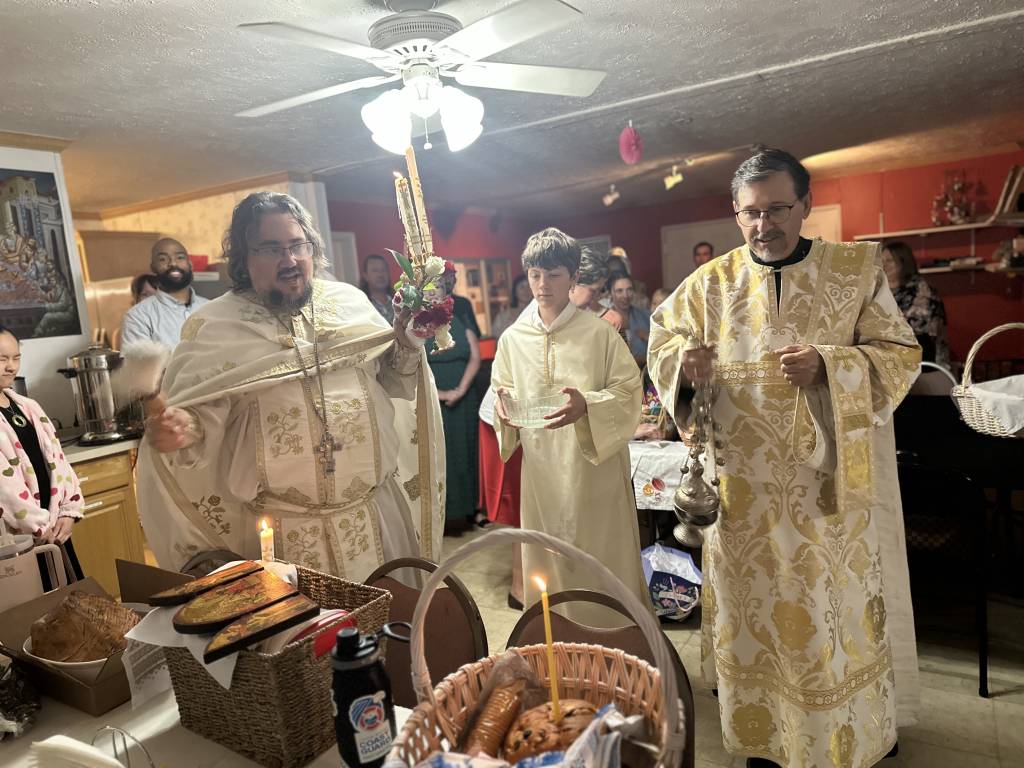
Many Orthodox Christians bring a basket of food to church on Pascha to be blessed after the Resurrection service or on the day of Pascha. This custom is rooted in the lived life of the historic Orthodox Church and remains a beautiful expression of thanksgiving today. It is not a replacement for Holy Communion, and it is not a superstition. It is a simple offering of festive food back to God in the joy of Christ’s Resurrection.
If you are new to Orthodoxy, you may wonder what goes in the basket, why people bring one at all, and how to prepare it in a reverent way. The Orthodox Church teaches that Christians do not live the faith only in the mind. We worship with the whole person through prayer, fasting, feasting, thanksgiving, and the life of the Church. Preparing a basket for Pascha is one small but meaningful part of that way of life.
How to Prepare Your Basket for Pascha in the Orthodox Church?
The Pascha basket belongs to the movement from Great Lent to the feast of feasts. During Lent, Orthodox Christians fast as an act of repentance, self-control, and love for God. Then, when Pascha arrives, the Church breaks into joy because Christ has trampled down death by death. The foods that were set aside during the fast are received again with thanksgiving and blessed as part of that festal joy.
This custom is not done exactly the same way in every place. Greek, Antiochian, Romanian, Russian, Serbian, and Ukrainian Orthodox Christians may all prepare baskets a little differently. The Eastern Orthodox Church allows these local customs to flourish, because the faith is one even when customs vary. What matters most is not showing off the basket, but bringing it with gratitude, peace, and reverence.
Orthodox Christians believe that all good things come from God and should be received with thanksgiving. Saint Paul writes, “For everything created by God is good, and nothing is to be rejected if it is received with thanksgiving” (1 Timothy 4:4). The Church blesses many parts of daily life because Christ has sanctified human life through His Incarnation, death, and Resurrection. That is why even food, when received properly, can become part of a life of worship.
What Foods Usually go Into an Orthodox Pascha Basket?
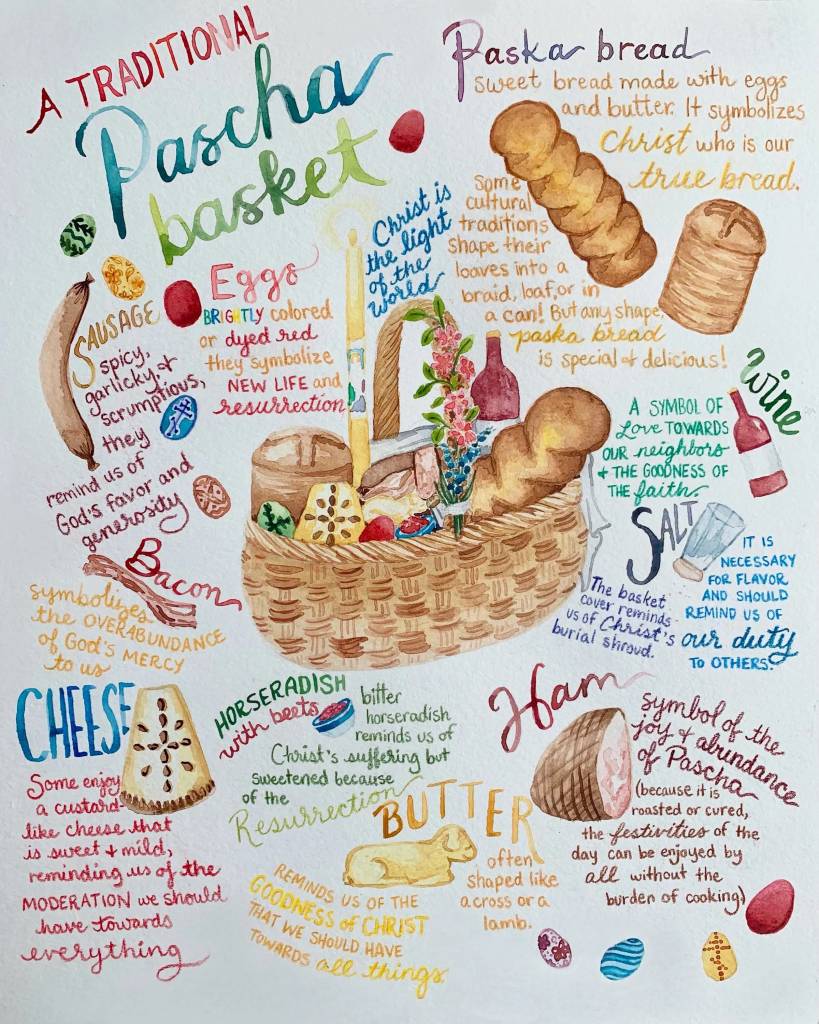
Most Pascha baskets contain festive foods that mark the end of the Lenten fast. Common items include red eggs, bread, cheese, butter, meat, and sometimes sausage or ham, depending on local tradition. In some places, families also include a special sweet bread or Pascha loaf. These foods are not random. They are signs of feasting after a season of restraint, prayer, and repentance.
Bread often has a central place in the basket because it speaks of joy, hospitality, and God’s daily care for His people. Cheese, butter, and meat are common because these rich foods were usually set aside during Lent. Their return to the table marks the movement from fasting to feasting. The basket therefore becomes a quiet witness that Pascha is not only a date on the calendar, but a real turning point in the life of Orthodox Christians.
At the same time, the Orthodox Church does not teach that there is one universal list that every family must follow. Some families keep strong ethnic traditions and prepare a more elaborate basket. Others bring only a few simple foods. A small basket prepared with faith and thanksgiving is better than a large one prepared for attention or praise. The spirit of the offering matters more than the size of the arrangement.
Why are Red Eggs so Important in an Orthodox Pascha Basket?
Red eggs are one of the most recognizable and beloved symbols of Pascha in Orthodox Christianity. The egg itself points to life hidden within what seems closed and lifeless. It becomes a fitting sign of the tomb, from which Christ rose in glory. The red color has long been connected to the blood of Christ and the victory that came through His saving death. On Pascha, Orthodox Christians do not color eggs red just to make the table look festive. We do it because the whole feast proclaims that life has burst forth from the grave.
For us at St. Mary Magdalene, the red egg carries an even richer meaning. Orthodox tradition remembers Saint Mary Magdalene going before the emperor Tiberius after the Resurrection of Christ. She came to him not with fear, but with boldness, carrying the witness of the empty tomb. In that encounter she proclaimed the central truth of the Christian faith: Christ is risen. The emperor doubted her, and in response the egg she held became red as a sign. That tradition has been handed down in the life of the Church as one of the reasons red eggs are associated with Pascha and with Saint Mary Magdalene in particular. You can read more about her life here: Life of St. Mary Magdalene.
That story is worth slowing down and dwelling on, especially for a parish under her patronage. Saint Mary Magdalene was not a minor figure standing somewhere at the edge of the Gospel story. She was one of the myrrh-bearing women. She stood near the Cross. She went to the tomb. She was among the first to hear the good news that Christ had risen. In Orthodox Christianity, she is remembered as Equal to the Apostles because she was sent to proclaim the Resurrection itself. That means the red egg is not only a symbol of Christ’s blood and new life. It is also tied to the mission of proclaiming the Resurrection with courage.
There is something deeply fitting about the sign itself. An egg appears closed, quiet, and ordinary. It looks like a dead thing, or at least a lifeless thing. Yet hidden within it is life. That image naturally speaks to Pascha. The tomb of Christ was sealed. It looked like the end. It looked final. But within the sealed tomb was not defeat, only the hidden power of divine life. When the Church places red eggs into the Pascha basket, she is not only remembering a custom. She is confessing the mystery of the Resurrection in a visible way.
The miracle before Tiberius also shows something important about how Orthodox Christians understand witness. Saint Mary Magdalene did not keep the Resurrection as a private comfort. She did not reduce it to a feeling in her heart. She announced it. She carried it into the world, even before power and unbelief. The red egg therefore becomes a sign not only of the event of Pascha, but of the duty of every Christian to bear witness to the risen Christ. It reminds us that the Resurrection is not merely something to admire. It is something to proclaim.
There is also a beautiful humility in the sign. God did not choose a jewel, a sword, or a crown to become one of the common symbols of Pascha. He allowed something simple and ordinary to carry the memory of His triumph. That is often how God works. He takes plain things and fills them with meaning. Water becomes the means of Baptism. Bread and wine become the Eucharistic offering. Oil is used for anointing. And even an egg, something found at an ordinary table, becomes a sign of the Resurrection and the witness of Saint Mary Magdalene.
For a parish like ours commemorated and dedicated after her, this is especially precious. The red egg should not be seen merely as a decoration placed into the basket because everyone expects it to be there. It can be taught as part of the very identity of the parish. When children in the parish dye red eggs, they are not only preparing for a meal. They are learning about Saint Mary Magdalene’s bold confession. They are learning that the Christian faith is not hidden away. They are learning that the news of the Resurrection is meant to be carried into the world with courage and joy.
That also means the red egg can become an invitation to speak about Pascha in the home. A family can ask why the egg is red. A parent can speak about the blood of Christ, the sealed tomb, the life hidden within the shell, and the witness of Saint Mary Magdalene before the emperor. In that way, the custom becomes more than visual. It becomes catechetical. It teaches the faith through an object small enough to fit in the hand, yet rich enough to open up the whole mystery of Pascha.
So when Orthodox Christians place red eggs in the Pascha basket, they are doing several things at once. They are remembering the Passion of Christ. They are proclaiming the new life of the Resurrection. They are honoring the witness of Saint Mary Magdalene. They are confessing that Christ is risen, not in an abstract way, but in a way that touches the table, the family, the parish, and the whole shape of Christian life. That is why the red egg deserves more than a passing mention. It stands at the heart of the Paschal basket as a quiet but powerful confession of the Gospel.
Does Every Orthodox Christian Have to Bring the Same Foods?
No. There is no single Orthodox law saying that every Pascha basket must contain the exact same things. Customs differ from one country to another and from one parish to another. Some people bring only red eggs and bread. Others bring cheese, butter, lamb, sausage, or a sweet bread. The Church allows these differences because the deeper meaning remains the same.
This is one of the helpful things to remember if you are new to the Orthodox Church. Orthodoxy has a stable faith and a living tradition, but not every custom is rigidly identical in every place. There is freedom in local practice, as long as the custom serves the truth of the feast. The basket should reflect the joy of Pascha and the gratitude of the faithful, not anxiety about getting every detail perfect.
Is Bringing a Pascha Basket Required in the Orthodox Church?
No. A Pascha basket is a pious custom, not a requirement for being an Orthodox Christian. Some parishes bless baskets every year, while others do not have the practice at all. A person is not less faithful because he does not bring one. The basket is meaningful, but it is not the center of the feast.
This point matters because Orthodox Christians must keep the right order. The center of Pascha is the Resurrection of Christ, the Paschal service, and the Holy Eucharist. Everything else, including the basket, is secondary. Beautiful customs help us enter into the life of the Church, but they should never replace what is essential.
Why Does the Orthodox Church Bless Food at Pascha?
The Orthodox Church blesses food at Pascha because the Christian life is marked by thanksgiving in all things. We do not simply stop fasting and begin eating without prayer. We return to the festal table under the blessing of God. This teaches us to feast as Christians and not merely to indulge ourselves after Lent.
Saint Paul says, “So, whether you eat or drink, or whatever you do, do all to the glory of God” (1 Corinthians 10:31). That verse captures the spirit of the Pascha basket very well. Even our celebration belongs to God. Even our joy is sanctified when it is received with thanksgiving. The blessing of Pascha foods reminds us that Christ’s Resurrection fills all of life with meaning, not just the hours we spend in church.
Saint John Chrysostom’s famous Paschal homily also helps us here. He calls everyone to enter into the joy of the Lord and to partake of the feast. That feast is generous, abundant, and filled with gladness. But it is still a holy feast. The blessing of the basket teaches that Christian joy is never separated from prayer, gratitude, and worship.
How Do You Actually Prepare a Basket for Pascha?
How do you Make a Pascha Basket in a Simple and Reverent Way?
Start with a clean basket or another neat container that is easy to carry. A simple woven basket is common, but the container does not need to be expensive or decorative. The goal is not to create a display piece. The goal is to bring a modest, reverent offering to church as part of the Paschal feast.
Next, line the basket with a clean cloth. In many Orthodox traditions, a white cloth is used because white reflects festal brightness and the joy of the Resurrection. Some families use a cloth that has been handed down from year to year. Others use a plain clean cloth. Either is fine, because the cloth is there to set apart the basket with care and dignity.
Then place the foods in the basket in an orderly way. Put in the items your family will actually eat and share after the blessing. A few red eggs, a loaf of bread, some cheese, and a small piece of meat are more than enough. It is better to make a basket that reflects your real life than one that is overloaded and impractical. The Orthodox Church teaches sobriety even in celebration.
After arranging the foods, many families cover the basket with another cloth. In some places a candle is added, though that depends on local custom and on what is practical in your parish. Some baskets are decorated with greenery or ribbon, but these things are secondary. Orthodox Christians should never feel pressure to make the basket look impressive. A beautiful Pascha basket is one made with gratitude and humility.
Finally, bring the basket to church at the time your parish has announced for the blessing. In some places baskets are blessed after the Paschal service in the early morning hours. In other places they are blessed later on Pascha day. The best approach is always to ask your priest or look to the custom of your own parish. Orthodoxy is learned through the living life of the Church, not through guesswork.
What Should the Basket Teach us Spiritually?
The Pascha basket should teach us that fasting and feasting belong together in the Orthodox life. We fast so that we may repent, pray, and learn mastery over our desires. We feast because Christ has conquered death and opened to us the joy of His Kingdom. Without fasting, feasting can become shallow and selfish. Without feasting, fasting can become heavy and joyless. The Church gives us both so that our life may be shaped by Christ.
The basket also teaches us that Christianity is not abstract. The Son of God truly became man, ate with His disciples, suffered in the flesh, died, and rose bodily from the tomb. Orthodox Christians believe that the material world matters because God Himself entered it. That is why ordinary things like bread, eggs, and shared meals can become signs of holy joy when offered back to Him.
It also teaches us gratitude. A basket is not meant to be a display of abundance for its own sake. It is an offering of thanks. The foods inside say, in a quiet way, that all we have comes from God and is to be received from Him. The Christian does not grasp at good things as though they are self-made. He receives them with thanksgiving and humility.
How Should Families Prepare the Basket Together?
Preparing the basket can be a very good family practice, especially for children. Children can help dye the eggs, place the bread in the basket, or help cover it with the cloth. In doing this, they learn that Pascha is not only spoken about in church. It is also lived in the home, at the table, and in the shared customs of Orthodox Christian life.
These things matter more than many people realize. A child may not remember every sermon he hears, but he may remember the smell of the bread, the sight of the red eggs, the brightness of the Paschal candles, and the joy of hearing “Christ is risen.” The Church forms us not only through explanations, but through participation. The Pascha basket can become one small but lasting way that the life of the Church sinks into the heart.
Families should also keep the custom peaceful and simple. There is no need to turn it into a project of stress or perfectionism. The Orthodox Church teaches that the home should be marked by prayer and peace, not needless pressure. A simple basket prepared together with gratitude will teach far more than an elaborate basket prepared in frustration.
What Should We Avoid When Preparing a Pascha Basket?
First, avoid superstition. The blessing of food is real, but it is not magical. The basket is not a good luck charm, and the blessed foods are not to be treated as though they have power apart from a life of faith, repentance, and thanksgiving. Orthodoxy is sacramental, but it is never magical.
Second, avoid turning the basket into the main focus of Pascha. It is easy for people to spend more time thinking about what goes in the basket than about Holy Week, the Passion of Christ, or the joy of the Resurrection. The basket is a good custom, but Christ Himself is the center of the feast. Everything in Pascha should point back to Him.
Third, avoid vanity. A Pascha basket is not meant to impress the parish or compete with other families. The Orthodox Christian life is one of humility. A basket prepared with simplicity, reverence, and gratitude is more fitting than one prepared to attract praise. The Lord looks at the heart before He looks at the arrangement.
How Does the Pascha Basket Connect us to the Life of the Parish?
One of the beautiful things about this custom is that it connects home and church. The foods of the home are brought into the life of the parish and placed under the blessing of the Church. In that way, the basket becomes a small bridge between family life and liturgical life. It reminds us that the Christian life is not split in two. What we do at home and what we do at church belong together.
For a parish named after Saint Mary Magdalene, that connection becomes even more meaningful. Her witness to the Resurrection was bold, joyful, and public. The red egg tradition tied to her name reminds us that Pascha is not only about private devotion. It is about bearing witness to the risen Christ. Even a basket can quietly preach that truth when it is brought with faith.
That is one reason customs like this matter. They may seem small, but they shape how a parish remembers, celebrates, and hands on the faith. A Pascha basket by itself will not make someone holy. But when it is joined to prayer, worship, fasting, and thanksgiving, it becomes part of the way the Orthodox Church forms her people in the joy of the Resurrection.
Preparing a basket for Pascha is a small but beautiful custom within the larger life of the Orthodox Church. It teaches thanksgiving, simplicity, and festal joy. It helps children remember the feast and reminds adults that even our meals should be received with gratitude. Most of all, it points beyond itself to the great truth at the center of Pascha: Christ is risen from the dead.
If you have never experienced Pascha in the historic Orthodox Church, come and see. Stand in the light of the candles, hear the hymns of the Resurrection, and enter into the life of the Church as it has been handed down through the centuries. Orthodox Christians believe that Christ is risen indeed, and the whole life of the Church, from the Paschal service to the blessed basket, bears witness to that joy.