Since Disney’s live-action Moana is now in theaters, this seems like a good week to return to the original animated film. I enjoy this movie, although one of the first-world problems of having children is that when Zoe was two years old, she wanted to watch it over and over again. I have heard the soundtrack far more times than I would like, and I suspect parts of it will remain in my head for the rest of my life.
Even so, Moana is a thoughtful and beautiful story. It is filled with courage, sacrifice, duty, healing, love for one’s people, and the desire to restore what has been broken. These themes matter because they touch on questions that every human being eventually asks about purpose, identity, suffering, and hope.
This is what makes the film a good fit for the “Almost Christian” series. The story is not Christian, and it should not be treated as though it secretly teaches the Orthodox faith. Yet it reflects fragments of truth that become clearer and fuller when seen through the life and teaching of the historic Orthodox Church.
Why Moana Feels Almost Christian
Stories often reveal what people long for, even when they do not fully understand where that longing comes from. We are drawn to heroes who give themselves for others, to broken things being restored, and to people who answer a calling greater than personal comfort. Orthodox Christians believe these desires are not accidental because the human heart was created for communion with God and with one another.
At the same time, stories can mix truth with ideas that do not fit the Christian understanding of the world. Moana draws heavily from Polynesian mythology, including divine forces within nature, spiritual ancestors, and a world in which the ocean acts with a will of its own. These elements are important to the story, but they are not the same as the biblical vision of creation.
The Orthodox Church teaches that creation is good because God made it, not because nature itself is divine. The sea can reveal the beauty, power, and wisdom of its Creator, but it does not possess a soul or independent will. As Psalm 95 says, “The sea is his, for he made it,” which places the ocean within creation rather than above it.
That distinction helps us appreciate the film without confusing its worldview with the Gospel. We do not have to reject every story that contains mythology, but we should learn to see clearly where it points toward truth and where it falls short. This kind of discernment is especially important when watching stories with children.
A Calling Greater Than Self-Fulfillment
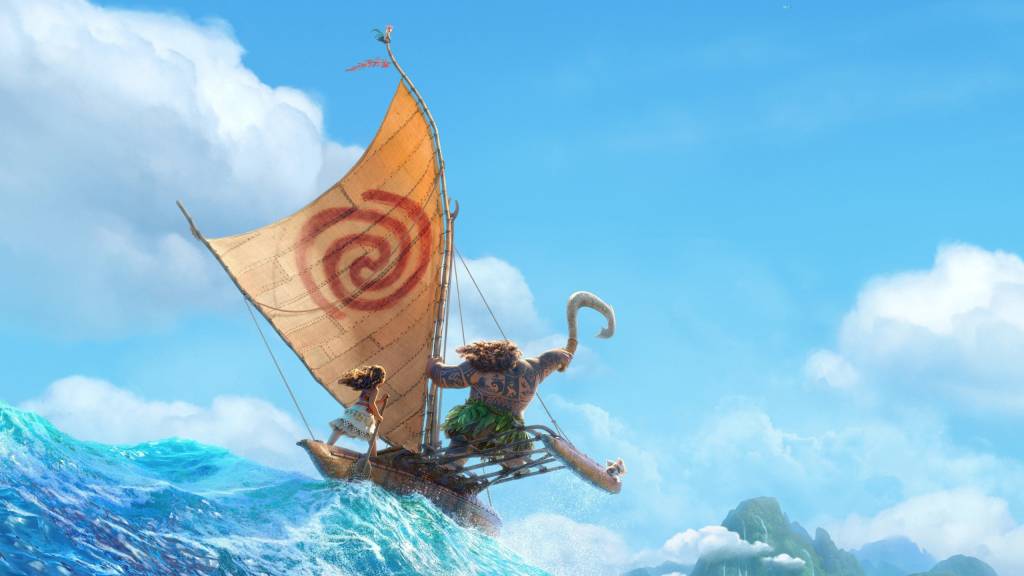
Moana is called to something greater than herself.
At the beginning of the film, Moana is torn between two desires. She loves her people and understands that she is expected to become their chief, but she is also drawn toward the sea and feels that she has a mission beyond the reef. The film presents this tension as part of her discovery of who she is.
Modern stories often describe identity as something we create entirely for ourselves. The message is usually that happiness comes from rejecting expectations, following personal desire, and becoming whoever we choose to be. Moana includes some of that language, but her story is more serious than simple self-expression.
Moana does not leave her island merely because she is bored or because she wants adventure. She leaves because her people are in danger and because she accepts responsibility for helping them. Her calling requires fear, sacrifice, uncertainty, and the possibility that she may never return.
This is where her journey begins to resemble a Christian understanding of vocation. In the Orthodox Church, a calling is not mainly about finding the life that makes us feel most fulfilled. It is about freely answering God’s invitation to love, serve, repent, and become faithful in the place where we have been set.
The prophets often responded to their call with fear. Moses protested that he was not able to speak well, Jeremiah said he was too young, and Jonah ran in the opposite direction. Yet God’s call was not based on their confidence or their natural strength.
Moana also begins with uncertainty. She is not fully prepared, she makes serious mistakes, and she sometimes wishes someone else could complete the mission. Her courage does not mean that fear disappears; it means she continues despite fear.
That is an important lesson for Christians. Faithfulness is not the absence of anxiety, weakness, or doubt. It is the decision to keep moving toward what is good even when obedience is difficult.
Orthodox Christianity also teaches that vocation is always connected to love. A person may be called to marriage, monastic life, priesthood, parenthood, teaching, caregiving, or hidden service, but no true calling exists only for the sake of the individual. Every Christian vocation becomes a way of offering one’s life for God and neighbor.
Moana’s mission follows this pattern in a limited but meaningful way. She risks her life not to prove that she is special, but to save her people from hunger and destruction. Her journey becomes less about discovering herself and more about accepting responsibility for others.
This does not mean that every part of her journey is Christian. The film still places great weight on inner identity and self-discovery. The phrase “You are who you choose to be” expresses a view of the human person that is incomplete from an Orthodox perspective.
Orthodox Christians believe that our identity is received before it is chosen. We are created in the image of God, wounded by sin, and called to become what we were made to be through grace. We do make real choices, but those choices do not create the truth of human nature from nothing.
Freedom is not the power to define good and evil for ourselves. It is the power to turn toward God, to love what is good, and to become truly human. The more we live in communion with God, the more fully we become ourselves.
Moana’s story comes close to this truth whenever her identity is tied to love, responsibility, and service. It moves away from it whenever identity becomes something discovered only by looking inward. The Christian life teaches us that we find ourselves most deeply not by inventing a new self, but by offering ourselves in love.
Restoring Creation Instead of Simply Defeating Evil
One of the most beautiful parts of Moana is that the story is not ultimately about defeating a monster. For most of the film, Te Kā appears to be nothing more than an evil force that must be overcome. Like many adventure stories, the audience expects the final battle to end with the villain’s destruction. Instead, the climax reveals something far deeper.
Moana realizes that Te Kā is actually Te Fiti after losing her heart. The answer is not violence but restoration. When the heart is returned, the monster disappears because what appeared to be evil was actually something good that had been wounded and distorted.
This is one of the strongest “almost Christian” moments in the film. The Orthodox Church teaches that evil is not something God created. Rather, evil is the corruption or distortion of what was originally good. The Fathers often described evil as a parasite that damages God’s creation but has no independent existence of its own.
St. Athanasius explains in On the Incarnation that humanity was created for communion with God but, through sin, fell into corruption and death. God’s work throughout history has been the work of restoration, healing, and renewal. That is why Scripture speaks not only about the salvation of people but also about the renewal of creation itself.
St. Paul writes in Romans 8 that creation itself groans while waiting for its redemption. The Bible does not present the created world as something disposable but as something that will ultimately be renewed. Humanity was placed in the garden to tend and keep it, showing from the very beginning that mankind was intended to be a faithful steward of God’s creation.
Moana’s mission echoes that calling in an imperfect but meaningful way. She is not simply trying to destroy an enemy. She is trying to restore harmony to the islands, bring life back to the land, and heal what has been broken. That longing for restoration resonates deeply because it reflects the way God intends His creation to flourish.
Of course, the comparison has limits. The restoration of Te Fiti is part of Polynesian mythology and should never be confused with the nature of God. Still, the longing to see broken things made whole points toward something every Christian recognizes. We were created not merely to survive in the world but to participate in God’s work of healing it through lives of holiness, mercy, and faithful stewardship.
Compassion Is Greater Than Vengeance
When Moana finally stands before Te Kā, she does something few heroes would do. She does not rush into battle. She does not seek revenge. She recognizes that beneath the rage is someone who has lost what made her whole.
That moment changes everything. Instead of destroying the monster, she makes room for healing. The film suggests that compassion can accomplish what violence never could.
Orthodox Christians should appreciate this instinct while also understanding its limits. Christianity does not teach that every act of evil is simply the result of misunderstanding or that repentance is unnecessary. Sin has real consequences, and God’s justice is real.
At the same time, the Church teaches us never to delight in another person’s destruction. God desires repentance, not revenge. We pray even for our enemies because hatred slowly reshapes our own hearts into the very thing we oppose.
The ending of Moana reminds us that healing is often a greater victory than punishment. While the film does not present the Christian understanding of sin and redemption, it does remind us that restoration is always more beautiful than simple destruction.
Why Self-Sacrificial Love Always Moves Us
Nearly every great story contains sacrifice because every human heart recognizes that genuine love costs something. We admire heroes not because they become powerful but because they willingly give themselves for others.
Moana repeatedly risks her own life for the sake of her people. She leaves the safety of her home, sails into dangerous waters, and continues even after failure and discouragement. Her journey is marked by perseverance rather than comfort.
Maui also experiences an important transformation. Throughout much of the film, he believes his magical fish hook gives him value. Without it, he thinks he is nothing. By the end of the story, he begins to understand that true worth is found not in possessing power but in using his gifts for others.
That lesson speaks to modern life as well. Many people build their identity around careers, achievements, popularity, possessions, or talents. When those things disappear, they wonder whether they have any value left.
The Orthodox Church teaches something very different. Human dignity does not come from success or ability. It comes from being created in the image of God. Everything else can be taken away, but that gift remains.
The reason sacrificial love resonates so deeply is because it reflects the pattern written into creation itself. Every parent who sacrifices sleep for a child, every husband or wife who serves the other in difficult times, every friend who remains faithful during suffering participates, however imperfectly, in the kind of love that finds its fullness in Jesus Christ. Disney was not trying to tell the Gospel, but audiences still recognize the beauty of sacrifice because it reflects something profoundly true about reality.
Courage Means Remaining Faithful
One of the things I appreciate most about Moana is that she is not fearless. She questions herself. She experiences failure. She wonders whether she has misunderstood her purpose. Yet she keeps going.
That is much closer to real courage than the modern idea of confidence without struggle. The saints were not fearless people. They were faithful people. They continued praying, serving, forgiving, and trusting God even when they felt weak.
Our own spiritual lives often look much the same. There are seasons when prayer feels difficult, when temptation seems stronger than usual, or when we wonder whether our efforts matter at all. Faithfulness means continuing to take the next faithful step even when the destination is not yet visible.
Moana reminds us that perseverance often matters more than dramatic moments of success. Holiness is usually formed through ordinary acts of obedience repeated over a lifetime rather than a single heroic moment.
Where Moana Falls Short of the Christian Faith
For all of its beauty, Moana is not a Christian story. It is rooted in Polynesian mythology, and that worldview differs from Orthodox Christianity in important ways.
The ocean is portrayed almost as a personal guide with its own will and purpose. Christianity teaches that the sea proclaims the glory of God because He created it, but creation itself is never divine or conscious. The waves obey their Creator, not their own desires.
Likewise, Te Fiti should never be viewed as an image of God. God is eternal, while Te Fiti comes into existence. God is all-powerful, while Te Fiti can be overcome. God is unchanging, while Te Fiti becomes Te Kā and then changes back again. The restoration of Te Fiti belongs entirely within the mythology of the film and should not be confused with the Christian understanding of God’s nature.
The final difference concerns identity. The movie leans toward the idea that we become who we choose to be. Orthodox Christians believe our identity begins with God. We are created in His image, wounded by sin, and called to become by grace what He created us to be. Our choices matter deeply, but they do not invent human nature. They either lead us toward communion with God or away from it.
Where Moana Points Beyond Itself
One of the reasons Moana continues to resonate with audiences is because it tells a story that reflects many of the deepest longings of the human heart. We long for a purpose greater than ourselves. We long to see broken things restored. We long for leaders who are willing to sacrifice for others rather than seek power for themselves. We long for hope when everything seems lost.
Those longings are not accidents. Orthodox Christians believe they exist because every person is created in the image of God. Even cultures that never knew the Gospel have often recognized pieces of truth about courage, virtue, sacrifice, and the desire for restoration. These glimpses are real, but they are incomplete apart from the fullness of God’s revelation.
This is why stories like Moana can become helpful conversation starters. Rather than asking only whether a movie is acceptable or unacceptable, we can ask what it teaches well and where it leaves us wanting something more. Parents especially can use films like this to help children think critically about the stories they love.
For example, you might ask, “Why did Moana choose to leave the island?” or “Why was restoring Te Fiti better than simply defeating Te Kā?” Those questions naturally open the door to conversations about vocation, forgiveness, stewardship, and sacrificial love. They also create opportunities to explain why Christianity ultimately offers a deeper answer to each of those themes.
The film reminds us that true leadership is not about gaining recognition but about serving others. It reminds us that courage is choosing faithfulness despite fear. It reminds us that healing is often a greater victory than revenge. Those are beautiful truths worth celebrating.
Yet the story also reminds us why beautiful themes alone are not enough. Without the true God, even the noblest stories eventually rest upon an incomplete foundation. Moana grounds its vision of hope in Polynesian mythology, animism, and a view of identity that leans toward self-definition. Orthodox Christianity teaches instead that our hope rests in the living God, that creation points beyond itself to its Creator, and that our identity is received as a gift rather than invented for ourselves.
That is why I believe Moana deserves the title “Almost Christian.” It reflects genuine Christian themes such as vocation, courage, sacrificial love, healing, compassion, and restoration. At the same time, it explains those themes through a worldview that is ultimately different from the Gospel.
As Orthodox Christians, we do not need to fear stories like this, nor should we baptize them into something they are not. Instead, we can appreciate what is good, recognize what is incomplete, and allow every beautiful story to point us toward the One in whom truth, beauty, and goodness are perfectly fulfilled.
After all, every great story leaves us longing for something greater. Every act of courage points toward perfect courage. Every sacrifice points toward perfect love. Every restoration points toward the day when all things will finally be made new. That is where the Christian story goes beyond every fairy tale and every myth ever told.
I hope this series helps you watch movies, read books, and enjoy music with greater discernment rather than greater fear. Culture is filled with echoes of the truth. Our task is to recognize those echoes, give thanks for what is good, and gently point ourselves and others toward the fullness found in the life of the Orthodox Church.
If you have a movie, television show, book, album, or other piece of media that you would like to see covered in a future installment of “Almost Christian,” feel free to email me, Fr. Stephen, at frsteve@savannahorthodox.com. I’d love to hear your suggestions.
And with that, I suppose there is only one fitting way to end an article about Moana… You’re Welcome.
Frequently Asked Questions
Is Moana a Christian movie?
No. Moana is rooted in Polynesian mythology and is not a Christian film. However, it contains themes such as courage, sacrifice, healing, and restoration that resonate with many biblical virtues while remaining incomplete apart from the Orthodox Christian faith.
Can Orthodox Christians watch Moana?
Yes. Orthodox Christians can appreciate the film while exercising discernment. The key is recognizing the difference between the virtues the story reflects and the mythological worldview in which those virtues are presented.
What does Te Fiti represent?
Within the story, Te Fiti represents the source of life and the restoration of the islands after her heart is returned. She should not be understood as a representation of the God of Christianity, since her nature, origin, and limitations are fundamentally different.
What is the Christian lesson in Moana?
The film encourages viewers to consider vocation, perseverance, compassion, stewardship, and self-sacrificial love. While these themes reflect genuine truths, Orthodox Christianity teaches that they find their fullest meaning in a life centered on God rather than mythology or self-defined identity.
Why do stories about sacrifice resonate so deeply?
People are naturally moved by sacrificial love because we were created in the image of a God who is love. Whenever a story portrays someone giving themselves for others, it reflects a reality that ultimately finds its fulfillment in Christ, even if the story itself is not Christian.