As the United States approaches the 250th anniversary of the Declaration of Independence, there has been a great deal of talk about liberty, sacrifice, and the meaning of the American story. Anniversaries can become occasions for self-congratulation, but they can also invite honest reflection. A nation should remember what it has achieved without hiding the painful distance between its proclaimed ideals and the lives of many of its people.
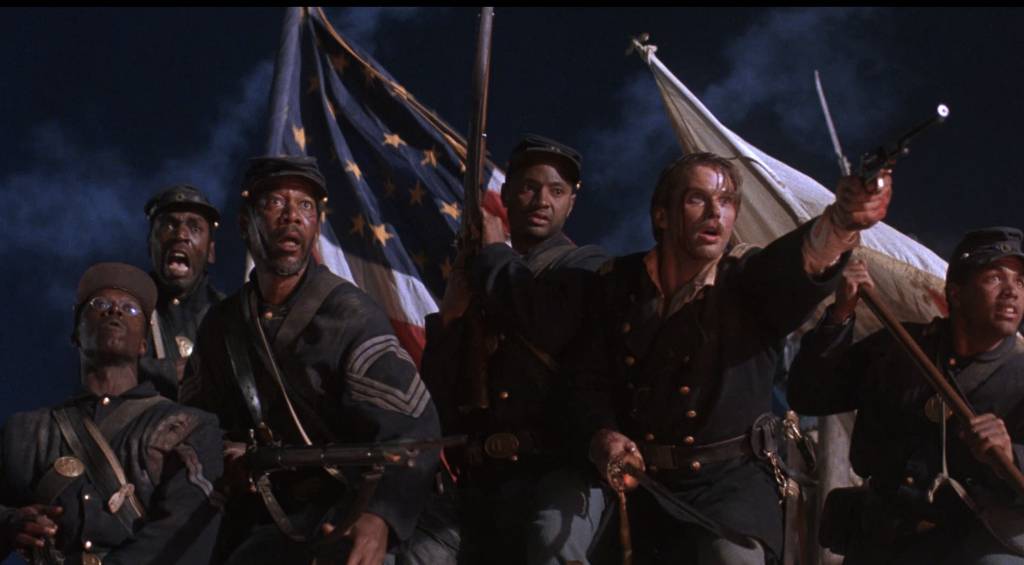
The 1989 film – Glory places us directly inside that tension. It tells the story of the 54th Massachusetts Volunteer Infantry, one of the first Black regiments raised in the North during the Civil War. Under Colonel Robert Gould Shaw, these soldiers entered a war fought in the name of the Union while also struggling against racism, unequal treatment, and a government that did not yet recognize their full dignity.
Glory has long been my favorite Civil War film, but watching it while living in the South gives it added weight. I was born in Biloxi, Mississippi, but I grew up on the West Coast, where Confederate monuments, flags, and other symbols were not part of the daily landscape in the same way. Since moving south, I have become much more aware of how Confederate iconography still radiates through the culture, sometimes as history, sometimes as nostalgia, and sometimes without enough thought about what it communicates to our neighbors.
Glory, Freedom, and the Image of God
I decided to watch Glory again after visiting Boone Hall Plantation near Charleston, South Carolina, earlier this week. Walking past preserved cabins where enslaved people lived makes slavery harder to reduce to a distant political question. Those buildings silently testify that the wealth, beauty, and social order of the plantation depended upon human beings being treated as property.
That experience also made the film’s setting feel much closer. The 54th Massachusetts fought near Charleston and led the assault on Fort Wagner on July 18, 1863. The attack failed to capture the fort, and the regiment suffered terrible losses, but its courage helped overturn the claim that Black soldiers could not fight effectively and encouraged the wider enlistment of Black Americans in the Union Army.
A brief warning is necessary before recommending the film. Glory is rated R and includes strong language, intense battle scenes, disturbing injuries, and a painful whipping scene. The violence is not constant, but it can be graphic, so parents should use discretion before showing it to children or younger teenagers.
This article is part of the Almost Christian series, which examines spiritual themes in popular media through the lens of Orthodox Christianity. These stories may reflect fragments of truth, beauty, sacrifice, love, and redemption while still falling short of the fullness of the faith. Glory is not an Orthodox film, and every theological idea within it should not be accepted without discernment, but it offers a powerful picture of human dignity and sacrificial love.
True Glory Is Found in Sacrificial Love
The title itself invites an important question: What is glory? The world often connects glory with fame, power, military victory, public recognition, or having one’s name remembered by history. The Gospel reveals something very different, because the glory of Jesus Christ is seen most clearly in His humility, His self-emptying love, and His willingness to lay down His life for others.
That distinction is at the heart of the film. The 54th does not achieve glory by winning the battle at Fort Wagner. The soldiers achieve a human reflection of glory by remaining faithful to one another and offering themselves for a freedom that many of them would not live to experience.
In John 15:13, Christ teaches that there is no greater love than laying down one’s life for one’s friends. The final charge in Glory echoes this truth, though the battlefield cannot fully reveal or fulfill the Gospel. The men advance knowing the danger, but they do so together, carrying the burdens of their brothers and accepting the cost of their shared calling.
Every Person Bears the Image of God
The first great Christian truth reflected in Glory is that human dignity does not come from the permission of the state. The soldiers of the 54th bear the image of God before the government allows them to enlist, before they receive uniforms, and before white officers acknowledge their courage. Slavery, racism, unjust laws, and cruel treatment can assault that dignity, but they cannot erase it.
Genesis teaches that humanity was created according to God’s image and likeness. This means that no person can rightly be reduced to property, labor, a racial category, or a tool for someone else’s prosperity. Orthodox Christians believe that every human life has sacred value, even when a society refuses to recognize it.
The film makes this visible through its individual characters. Thomas is educated and grew up around Shaw’s family, while Trip has been hardened by abuse and carries scars from slavery. Rawlins possesses quiet wisdom, and Jupiter Sharts begins as a frightened man who has barely handled a rifle. They are not presented as a single faceless group, but as persons with different histories, fears, gifts, and wounds.
This is one reason remembrance matters. History often reduces armies to troop numbers and casualty lists, but people are not statistics. When Glory gives these men names, faces, conversations, prayers, and relationships, it restores something that racism tried to deny: each of them was a unique person whose life mattered.
Brotherhood Crosses Race, Education, and Social Status
The regiment brings together educated men, former slaves, laborers, officers, and men who have known very different forms of freedom. At first, these differences create suspicion and conflict. Over time, shared suffering forms a bond that social rank alone could never produce.
This brotherhood is not sentimental. The men argue, fight, misunderstand one another, and carry their own prejudices. Yet they gradually learn that they need one another, and their shared purpose becomes greater than the divisions that first defined them.
The Church offers an even deeper unity. Saint Paul writes that in Christ there is neither Jew nor Greek, slave nor free, because all are one in Him. This does not erase culture, history, or personal identity, but it means that none of these things determines a person’s value or place within the household of God.
Parish life should make this unity visible. People who might never have chosen one another as friends stand together in prayer, receive the same Holy Mysteries, and learn to call one another family. The unity glimpsed within the 54th becomes complete only when human fellowship is rooted in communion with God.
Shaw Must Learn to Command Through Service
Colonel Shaw begins with good intentions, but good intentions are not the same as purified love. He must confront his own assumptions and learn that his soldiers are not merely symbols in a noble social cause. They are men entrusted to his care, and leadership requires him to know their suffering and risk his own position for their welfare.
His transformation becomes visible when he challenges the unequal pay offered to Black soldiers, confronts the quartermaster over the lack of shoes, and shares the dangers imposed upon his men. He earns their trust because he begins to bear their burdens. Authority becomes credible when it is joined to sacrifice.
This reflects the Christian understanding of leadership. Authority is not given so that one person may dominate another or protect his own comfort. Whether exercised by a priest, parent, employer, officer, or public servant, authority should serve, protect, correct, and accept responsibility for those placed under its care.
Shaw remains an imperfect man, and the film should not be read as though his growth erases the unequal system around him. Yet repentance often begins when we stop treating people as ideas and begin loving them as persons. He becomes a better leader when he learns to stand beside his soldiers rather than merely above them.
Trip Must Discover Freedom from Hatred
Trip’s anger is neither shallow nor difficult to understand. He has known cruelty, racism, and betrayal, and he has little reason to trust promises made by white officers or the government. His anger grows from wounds that are real, not imagined.
Yet understandable anger can still become spiritually destructive. Hatred promises strength, but it binds the wounded person to the one who caused the wound. It may keep a person alert to danger, but it cannot heal the heart or create the brotherhood for which Trip secretly longs.
The film does not resolve Trip’s pain through a simple speech. Instead, his heart changes as he experiences loyalty, shared suffering, and love from men who refuse to abandon him. He begins to discover that brotherhood can offer something hatred never can: the freedom to belong without surrendering the truth about what happened.
Orthodox Christianity does not ask victims to pretend that evil was harmless or that trust must be restored without repentance. Forgiveness is not denial, and it does not forbid wise boundaries. It is the difficult refusal to let another person’s sin become the permanent ruler of our heart.
The Prayer Meeting Reveals the Soul of the Regiment
One of the strongest scenes in Glory takes place before the final battle. The soldiers gather to pray, sing, offer testimony, reconcile with one another, and prepare themselves for death. For a brief moment, the regiment becomes something more than a military unit. It resembles a congregation preparing to face judgment together.
The scene is not an Orthodox service and its religious language comes from a Protestant Christian tradition. Still, it reflects the ancient Christian instinct that death should be faced with prayer, repentance, reconciliation, and trust in God. No one should willingly approach death while clinging to hatred or refusing peace with his brother.
Rawlins gives thanks, Trip finally speaks from his heart, and the men answer one another as a community. Their prayer does not guarantee victory or protect them from suffering. Instead, it gives them the courage to face what lies ahead without being spiritually alone.
Orthodox Christians prepare for death through a lifetime of repentance, prayer, confession, Holy Communion, and reconciliation. We do not wait until danger is near to begin making peace with God and our neighbor. Every Divine Liturgy teaches us to commend ourselves, one another, and our whole life to Christ our God.
The Orthodox Church Views War as Tragedy
Glory presents courage in battle, but Orthodox Christianity does not romanticize war. The Church does not embrace a formal just war theory in the same manner that developed in parts of Western Christianity. Rather than declaring war morally pure when certain conditions are met, the Eastern Orthodox Church continues to see every war as evidence of a fallen world.
There may be times when military force is used to defend the innocent, restrain aggression, or prevent an even greater evil. A soldier may act with courage, mercy, and self-sacrifice while protecting others. Even then, killing remains a wound that calls for mourning, repentance, and spiritual healing.
Saint Basil the Great distinguished killing in war from ordinary murder, yet he still advised a period away from Holy Communion because the soldier’s hands were not clean. His approach holds together two truths that modern arguments often separate. A person may fight for a necessary cause without pretending that taking human life has become spiritually harmless.
This is especially important in a civil war. People of the same nation, neighbors, relatives, and often fellow Christians turn weapons against one another. Whatever political or military goals are involved, a civil war exposes a terrible breakdown of communion and leaves wounds that can remain for generations.
Could Peace Have Justified Allowing Slavery to Continue?
The Civil War forces us to face a painful moral question. Peace is good, but can peace be preserved by allowing slavery and grave injustice to continue? A quiet society is not truly peaceful when some of its members live under violence, exploitation, and the constant threat that their families may be separated.
Christian peace cannot simply mean the absence of open conflict. The prophets repeatedly condemned those who spoke of peace while ignoring injustice. Peace without truth becomes a way for the comfortable to ask the suffering to remain silent.
At the same time, Christians must never speak lightly about the death and destruction of war. A righteous cause does not make every action committed in its name righteous. The Union’s opposition to slavery did not remove every prejudice from its army, excuse every act of violence, or make its leaders free from the need for repentance.
Glory holds these truths together better than many war films. The cause of freedom matters, and the soldiers’ courage is worthy of honor. Yet the battlefield remains horrifying, the dead remain dead, and victory never turns killing into something beautiful.
Faithfulness is Greater than Visible Victory
The 54th Massachusetts does not capture Fort Wagner. Colonel Shaw is killed, many of his soldiers fall, and the survivors are forced back. If success is measured only by immediate military results, their charge appears to be a failure.
Yet their faithfulness changes what becomes possible after them. Their courage challenges racist assumptions, inspires further enlistment, and helps open the way for thousands of Black soldiers to serve. They lose the battle, but their sacrifice becomes part of a larger movement toward freedom.
Christianity also teaches us not to measure faithfulness only by visible results. We may speak the truth and be rejected, serve quietly without recognition, or labor for a change we will not live to see. God asks us to be faithful, while the final outcome belongs to Him.
This does not mean suffering is automatically redemptive. Pain can embitter, destroy, or be imposed unjustly upon the innocent. Suffering becomes redemptive when it is freely joined to love, truth, repentance, and the good of others rather than worshiped for its own sake.
The Burial Scene Reveals the Equality Society Denied
At the end of the film, officers and soldiers are placed in the same burial trench. Shaw lies beside Trip, and the ranks and divisions that governed their lives can no longer separate them. Death reveals the equality that society had refused to honor while they were alive.
The scene is painful, but it is also deeply human. The powerful and powerless, the honored and forgotten, the wealthy and poor all return to the earth. No uniform, title, monument, or social position can follow us into the grave.
The Christian answer to death, however, is not that our differences disappear into nothingness. Each person remains known and loved by God, and each will be raised. The forgotten soldier, the enslaved laborer, and the person whose name never entered a history book are not forgotten before the throne of God.
This gives Christian remembrance its seriousness. When the Church prays for the departed, we confess that a human life is not erased by death or by the neglect of history. Love remembers because God remembers.
America Must Live the Freedom it Proclaims
The Declaration of Independence speaks of equality and rights given by the Creator, yet the nation that proclaimed those words continued to enslave human beings. That contradiction should not lead us to despise every American ideal, but neither should patriotism require us to hide the contradiction. Love of country should include the desire to see its best beliefs become lived truth.
National self-righteousness becomes dangerous when we imagine that sin belongs only to another region, party, generation, or group. The Confederate defense of slavery must be named honestly, but the North also carried deep racism, unequal laws, and resistance to treating Black Americans as equals. Glory repeatedly shows that wearing the Union uniform did not automatically purify the heart.
Orthodox Christians believe that repentance applies to communities as well as individuals. Repentance does not mean hating our ancestors or refusing gratitude for what is good. It means telling the truth, mourning evil, correcting injustice, and refusing to pass inherited hatred to the next generation.
The 250th anniversary of the Declaration of Independence should therefore be both a celebration and an examination of conscience. Freedom is not merely something our nation announced in 1776 or achieved once for all in 1865. It is a responsibility to recognize the image of God in every neighbor and to defend the dignity of those whom society would rather overlook.
The Glory of the 54th Points Beyond Itself
Glory is almost Christian because it recognizes that true greatness is found in sacrificial love rather than domination. It honors brotherhood across social boundaries, leadership through service, repentance, remembrance, and faithfulness without visible success. These are real echoes of the Gospel, even though the film cannot offer the sacramental life, healing, or complete hope found within the Church.
The soldiers’ final charge is moving, but military sacrifice is not the center of Christianity. The goal of the Christian life is not to die dramatically or to become remembered as a hero. It is to be united to God, healed of sin, and transformed into a person capable of loving both friend and enemy.
Popular stories can awaken moral longing, but they cannot complete it. A film may move us to tears for two hours and still leave our daily habits untouched. The life of the Church calls us beyond admiration into repentance, prayer, mercy, forgiveness, worship, and concrete service to our neighbors.
True glory is not found in power, recognition, military triumph, or national pride. It is found in seeing the image of God in others and laying down one’s life in love. Glory gives us a moving glimpse of that truth, but the Orthodox Church invites us to live it.
Almost Christian will continue examining stories that contain fragments of truth while falling short of the fullness of the faith. Suggestions for future films, music, books, or other media may be submitted to me, Fr. Stephen, at frsteve@savannahorthodox.com. Check back next week when we dive into the movie The Patriot.
Frequently Asked Questions About Glory and Orthodox Christianity
Is Glory a Christian movie?
Glory contains prayer, sacrifice, forgiveness, and other Christian themes, but it is not an Orthodox film or a complete presentation of Christianity. It is almost Christian because it reflects fragments of truth that find their fullness within the life of the Church.
What is the main spiritual message of Glory?
The film suggests that true glory comes through courage, brotherhood, service, and laying down one’s life for others. From an Orthodox perspective, these virtues become complete when they are united to repentance, love of enemies, and communion with God.
Does the Orthodox Church believe in a just war?
The Orthodox Church may recognize that force is sometimes used to defend the innocent, but it does not treat war as morally pure or spiritually harmless. War remains a tragedy that requires mourning, repentance, and healing, even when soldiers have fought for a necessary cause.
Why was the 54th Massachusetts important?
The regiment’s courage at Fort Wagner challenged racist claims that Black men could not serve effectively as soldiers. Although the assault failed, their sacrifice encouraged wider Black enlistment and helped advance the struggle for freedom.
Is Glory appropriate for children?
Glory is rated R and includes strong language, intense combat, graphic injuries, and a disturbing whipping scene. Parents should consider a child’s age and sensitivity before watching it together.