


Christians cannot speak about violence as if it were a simple topic. The Orthodox Church teaches that every human person is made in the image of God, that hatred poisons the soul, and that Christ commands His disciples to love even their enemies. At the same time, the Church also knows that we live in a fallen world where innocent people sometimes need protection.
Because of this, Orthodoxy does not glorify violence, but it also does not teach a blind or careless pacifism. The Church calls us to peace, forgiveness, courage, self-control, and repentance. When difficult situations arise, the question is not, “How can I justify myself?” but, “How do I remain faithful to Christ while loving and protecting my neighbor?”
Christ, Forgiveness, and the Way of Peace
Our starting point is always Jesus Christ. He says, “Love your enemies, bless those who curse you, do good to those who hate you, and pray for those who spitefully use you and persecute you” (Matthew 5:44). He teaches us to forgive “seventy times seven” (Matthew 18:22). From the Cross, He prays for those who crucify Him: “Father, forgive them, for they do not know what they do” (Luke 23:34).
This is not sentimental language. Christ is not telling us to pretend evil is good. He is teaching us that hatred cannot be allowed to rule the heart. A Christian may have to face evil, resist evil, report evil, or protect someone from evil. But he must not become evil in the process.
The Church has always honored peacemaking because Christ Himself says, “Blessed are the peacemakers, for they shall be called sons of God” (Matthew 5:9). Peacemaking is not weakness. It is the work of people who have learned to control their anger, refuse revenge, and seek the salvation of all.
This is why the Orthodox Church rejects hatred, vengeance, cruelty, and bloodlust. These things belong to the passions, not to the Kingdom of God. A person can quote religious words while still being ruled by anger. It is possible to speak about justice while secretly enjoying the thought of another person suffering.
St. Paul writes, “Repay no one evil for evil” and “do not avenge yourselves” (Romans 12:17, 19). He does not say that evil has no consequences. He says that vengeance does not belong to us. The Christian heart must be guarded from the desire to punish others for the sake of personal satisfaction.
The saints show us this clearly. St. Dionysius of Zakynthos is remembered for forgiving the man who murdered his own brother. The murderer came to him, not realizing who he was, and St. Dionysius protected him from those seeking revenge. This was not because murder is unimportant. It was because the saint refused to let grief become hatred.
The Desert Fathers teach the same spirit. St. Euprepius said, “Bodily things are material and temporary. He who loves the world loves occasions of falling.” His teaching was not about being careless with life. It was about freedom from possessiveness, rage, and the need to control everything. The Christian who is not chained to worldly things is harder to provoke and quicker to forgive.
Forgiveness, however, is not the same thing as removing all earthly consequences. This is a common misunderstanding. A victim may forgive an abuser and still call the police. A parish may forgive a dangerous person and still remove him from access to children. A Christian may pray for an enemy and still testify truthfully in court.
Forgiveness means I release hatred and entrust judgment to God. It does not mean I pretend harm did not happen. It does not mean I enable evil. It does not mean I force victims to be silent. In the Church, mercy and truth belong together.
Martyrdom, Monasticism, and the Spiritual Battle
The martyrs are among the greatest witnesses of the Orthodox faith. They accepted death rather than deny Christ. They did not die because they loved pain or wanted attention. They died because faithfulness to Christ mattered more than earthly life.
The martyr does not seek death for its own sake. The Church has never blessed reckless behavior that chases suffering in order to feel holy. There is a difference between seeking martyrdom and accepting martyrdom when faithfulness requires it. A Christian should not run toward danger out of pride, fantasy, or spiritual immaturity. But if he must choose between denying Christ and suffering for Christ, he must remain faithful.
This matters because some people romanticize martyrdom. They imagine dramatic moments of courage while neglecting daily repentance, patience, prayer, confession, and love. But most of Christian life is not dramatic. It is quiet faithfulness. It is forgiving the person who irritated you, resisting sinful thoughts, praying when tired, telling the truth, and serving those in front of you.
After the age of open persecution, monasticism became a powerful witness in the life of the Church. But monasticism did not simply begin because martyrdom disappeared. From the beginning, Christians practiced prayer, fasting, celibacy, poverty, watchfulness, and spiritual discipline. Monasticism grew as a clear and concentrated form of the Christian life.
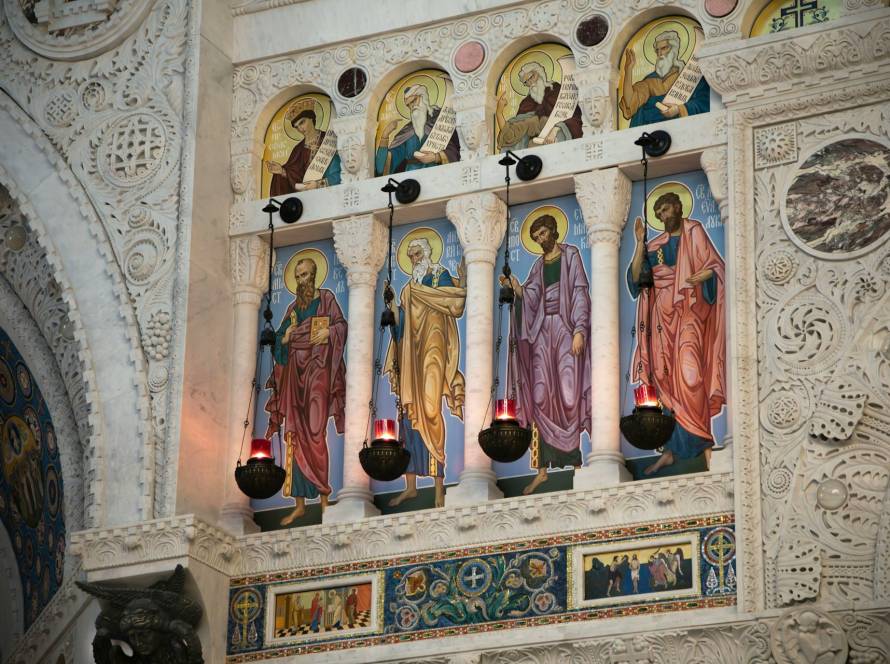
The monk goes into the desert, the monastery, or the cell not to escape love, but to fight the passions. This is the true war every Christian must face. Pride, lust, greed, anger, envy, gluttony, despair, and love of comfort are enemies within the heart. St. Anthony the Great, St. Macarius, St. Mary of Egypt, and the other great ascetics show us that the deepest battle is not first against other people, but against sin within ourselves.
Later spiritual writers sometimes used the phrase “white martyrdom” to describe the bloodless suffering of ascetic life. This language can be useful if understood rightly. It does not mean monasticism is pretend martyrdom. It means that the same total offering of the self to Christ can be lived through prayer, fasting, obedience, repentance, and hidden sacrifice.
This also helps us think clearly about violence. The Christian life is not about proving toughness. It is not about becoming passive either. It is about becoming free from the passions so that, when action is needed, we act from love and responsibility, not fear, hatred, pride, or fantasy.
War, Self-Defense, and Protecting the Innocent
The Orthodox Church does not glorify violence, even when violence occurs in war or self-defense. In some traditions, war has been described as “just” in a way that can sound noble or even holy. Orthodoxy is more cautious. The Church may recognize that force is sometimes used in a fallen world, but it does not treat killing as spiritually clean or good.
This is why the ancient canons are so important. St. Basil the Great, in his canonical letters, says that soldiers who kill in war should abstain from Holy Communion for a period of time. His treatment is pastoral, not simplistic. He recognizes that soldiers may be defending others, but he also recognizes that taking human life wounds the soul.
The Church’s approach is not ideological. It is pastoral. The Church does not begin with slogans like “all violence is always the same” or “violence is always justified if the cause is right.” Instead, the Church asks what happened, why it happened, what was in the heart, who was harmed, what repentance is needed, and how healing can begin.
This is why Orthodoxy does not teach blind pacifism or militarism. Blind pacifism can refuse responsibility for the vulnerable. Militarism can baptize violence and make strength into an idol. Both are dangerous. The Orthodox Christian must reject both cowardice and cruelty.
There is a real difference between personal vengeance and protecting innocent people. Personal vengeance says, “I want to make this person pay because I am angry.” Protection says, “I must act because someone vulnerable is in danger.” Vengeance is centered on the self. Protection is centered on love of neighbor.
A father protecting his family, a neighbor intervening to stop serious harm, a parish taking steps to protect children, or a community resisting violent attack can be acting from responsibility and love. But even then, the Christian must be sober. The goal is not domination, revenge, or proving courage. The goal is to preserve life and restrain evil as much as possible.
Are Christians taking up arms to defend themselves against oppression acting as Christians? Sometimes protecting the innocent from violent oppression may be a tragic responsibility in a fallen world. Oppression is evil, and Christians are not required to watch passively while families, neighbors, churches, or communities are destroyed. But the Church does not call violence holy simply because the cause is just. If force is used, it must be restrained, defensive, and ordered toward the protection of life, never toward revenge, hatred, ideology, or bloodlust.
This is not revolutionary romanticism. Christians should be very careful about baptizing political rage with religious language. A movement may use words like freedom, justice, defense, or resistance, but the Christian still has to ask what spirit is actually at work. Is this about protecting the vulnerable, or is it about hatred? Is this sober necessity, or is it fantasy? Is this love of neighbor, or is it the desire to destroy an enemy?
There may be tragic moments when people resist violent oppression to protect their homeland, their parish, their children, or their neighbors. The Church has historically blessed soldiers, prayed for civil authorities, prayed for deliverance from enemies, and honored those who protected the innocent. But the Church also prays constantly for peace and never teaches that killing becomes good simply because it may become necessary.
Some actions in a fallen world may be tragic rather than “good.” This is a very important Orthodox distinction. A person may do what is necessary to stop grave harm and still grieve that such action was necessary. The Christian does not rejoice in the death or injury of another human being, even an enemy. Every person remains a human being made in the image of God.
This is also why repentance may still be needed after justified violence or warfare. Repentance does not always mean, “I did the exact wrong thing.” Sometimes repentance means bringing the whole wound before God. A soldier, police officer, victim, or defender may need confession, prayer, counsel, and time for healing. The Church is a hospital, not only a courtroom.
The Orthodox services constantly pray for peace. We pray “for the peace from above and for the salvation of our souls,” “for the peace of the whole world,” and “for this city, every city and country, and the faithful dwelling in them.” These prayers are not decorative. They teach us what the Christian heart should desire. Even when the world is violent, the Church prays for peace because peace is the life of the Kingdom.
Christians should also think about safety and preparedness with sobriety. It is not wrong to lock doors, make wise plans, protect children, train responsibly, or prepare for emergencies. Prudence is not a lack of faith. But fear must not become our master.
The danger is that safety can become an idol. A person can become so focused on threats that he loses prayer, peace, mercy, and trust in God. The Christian should be prepared, but not paranoid. Watchful, but not ruled by fear. Responsible, but not obsessed.
There is also a danger in romanticizing violence. Some people speak as if defending others would automatically be heroic, simple, and clean. Real violence is ugly. War is ugly. Serious self-defense is ugly. The Church teaches us not to fantasize about these things, but to pray that we may never face them, and to act faithfully if we must.
Living faithfully in a violent and fallen world means staying centered on Christ. We forgive. We pray for enemies. We protect the innocent. We repent. We refuse hatred. We seek peace. We do not confuse the Kingdom of God with worldly power, and we do not confuse Christian love with passivity in the face of evil.
Most Commonly Asked Questions
Does Orthodox Christianity teach pacifism?
Orthodoxy honors peacemaking, forgiveness, and nonviolence, but it does not teach a blind pacifism that ignores the protection of innocent people. The Church recognizes that we live in a fallen world where force may sometimes be used to restrain evil. Even then, violence is treated as tragic and spiritually serious, not as something to celebrate.
Can an Orthodox Christian defend his family or parish?
Yes, protecting family, neighbor, and parish can be an act of responsibility and love. But the Christian must guard his heart from rage, revenge, cruelty, or fantasies of violence. The goal is protection, not punishment or pride.
Are Christians allowed to take up arms against oppression?
The Orthodox Church does not answer this with a simple slogan. Protecting the innocent from violent oppression may sometimes become a tragic responsibility, but Christians must never turn resistance into hatred, revenge, or political idolatry. Even when force is used defensively, it remains spiritually serious and must be brought before God with repentance, prayer, and pastoral guidance.
Why did the martyrs accept death instead of fighting back?
The martyrs accepted death because denying Christ would have been spiritual death. They were not chasing suffering, and they were not acting out of hatred for the world. They bore witness that Christ is Lord and that eternal life is greater than earthly survival.
What should I do next if I am struggling with this topic?
Start with prayer, confession, and honest conversation with your priest or catechist. Do not build your understanding from internet arguments, political slogans, or fear. Learn the mind of the Church slowly through Scripture, the lives of the saints, the services, and pastoral guidance.
Living this teaching in Christ: The Orthodox Christian life is not lived in theory. We learn to love enemies by praying for real people. We learn forgiveness by forgiving actual wounds. We learn courage by protecting those entrusted to us without surrendering our souls to hatred.
Christ stands at the center of this whole teaching. He is the crucified and risen Lord, the One who forgives His enemies and defeats death without becoming captive to evil. In Him, we learn how to live faithfully in a violent world while still belonging to the Kingdom of peace.
If you’re working through this and need guidance, reach out to Fr. Stephen at frsteve@savannahorthodox.com AND Anthony at anthony@anthonyally.com. CC us both.
1 Comment
Sean
Thank you, I needed this.