The recent death of Hayden Panettiere got me thinking again about a video game series that has been part of my life for more than two decades. Panettiere was known for many roles, including Heroes (“save the cheerleader, save the world” is still one of the worst lines in TV history…just saying), Nashville, Remember the Titans, and Scream, but my favorite will always be her performance as Kairi in Kingdom Hearts. She first gave Kairi her English voice in the original game and returned to the character in later entries. May her memory be eternal.
Kingdom Hearts has a special place in my family as well. One of my wife, Mat. Lindsey’s goddaughters back in Colorado is named after Kairi and even one of our Shih Tzus is named Sora after the series’ main character. That probably tells you something about how much these games have meant to me. Kingdom Hearts is my favorite video game series of all time and returning to it after Panettiere’s death reminded me how many of its themes have stayed with me.
Kingdom Hearts is not a Christian video game, much less an Orthodox Christian one. It began as one of the strangest collaborations in video game history, bringing together Disney and the Japanese game company Square, now Square Enix. The basic idea was almost unbelievable at the time: take the worlds and characters of Disney and place them inside an action role-playing game shaped by the developers behind Final Fantasy. Somehow, Mickey Mouse, Donald Duck, Goofy, Cloud Strife, and a new spiky-haired hero named Sora were going to exist in the same universe.
The story of how that collaboration began has become part of Kingdom Hearts history. Square and Disney once had offices in the same building in Japan, and producer Shinji Hashimoto encountered a Disney executive in an elevator. Conversations between the two companies eventually grew into the project that became Kingdom Hearts. Tetsuya Nomura, already well known for his character design work on Final Fantasy, took responsibility for directing the game. Development of the first Kingdom Hearts began around 2000, and the game was released in 2002. The Disney connection was never simply decoration. Sora travels alongside Donald and Goofy through worlds based on films such as Aladdin, Hercules, The Little Mermaid, Peter Pan, Beauty and the Beast, and The Nightmare Before Christmas. Mickey is a king, Donald is his court magician, and Goofy is captain of the royal knights. Later games expanded the Disney side of the universe to include everything from Pirates of the Caribbean and Tron to Toy Story, Frozen (Zoe likes watching me play this part because they recreate the “Let It Go” sequence almost exactly as it appears in the movie, but with Sora, Donald, and Goofy worked into the scene.), Tangled, and Big Hero 6.
But Kingdom Hearts quickly became much more than a tour through Disney movies. What begins with Sora searching for his friends Kairi and Riku eventually grows into a story spanning ancient Keyblade wielders, Heartless, Nobodies, Organization XIII, sleeping worlds, lost memories, fractured identities, and a conflict stretching across generations. The series combines the familiar worlds and characters of Disney with the elaborate storytelling and visual style associated with Japanese role-playing games.
That unusual marriage between Disney and Square is part of what makes the series work. Disney stories have long dealt with questions about love, sacrifice, temptation, death, friendship, good, and evil. Kingdom Hearts takes those familiar themes and places them inside a larger story centered on the human heart. As Sora moves from one world to another, the particular story may change, but the larger questions remain: What happens when darkness enters the human heart? Can someone who has fallen be restored? Why do we need other people? Can love survive separation and death? What does it mean to give yourself for another?
None of this means that Kingdom Hearts is secretly Christian. Its strange and increasingly complicated mythology draws from many sources, and we should not force Christian meanings onto a story that was never intended to teach Christian theology. But the combination of Disney’s moral storytelling and Kingdom Hearts’ constant focus on light, darkness, sacrifice, friendship, and the human heart gives Christians plenty to think about. Those echoes of truths that Christianity understands more fully are precisely what make Kingdom Hearts almost Christian.
The Heart, the Darkness, and the Light
The central symbol of Kingdom Hearts is right there in its name: the heart. Throughout the series, the heart means far more than emotion. Hearts contain memory, identity, desire, love, friendship, and the mysterious bond between persons. A heart can be wounded, stolen, corrupted, divided, restored, or connected to another heart. In the world of Kingdom Hearts, to speak about the heart is really to speak about the deepest part of the person.
That language should sound familiar to Christians. In Scripture, the heart is not simply the place where we feel emotions. It is the spiritual center of the human person, the place of desire, thought, choice, and encounter with God. “Blessed are the pure in heart, for they shall see God” (Matthew 5:8). The Orthodox spiritual tradition therefore speaks constantly about guarding and purifying the heart.
Kingdom Hearts also understands something important about darkness. Darkness is powerful and dangerous, but it does not create anything truly good or beautiful of its own. It invades, distorts, consumes, and corrupts what already exists. That comes surprisingly close to the Christian understanding of evil, not as some eternal force equal to God, but as a corruption of the good.
St. Augustine famously described evil as a privation of good, and the Eastern Fathers likewise rejected the idea that evil possesses an independent nature. St. Basil the Great taught that evil does not have its own substance but arises through our departure from the good. Darkness needs something good to darken. Sin needs something beautiful to disfigure.
When Darkness Enters the Heart
The danger in Kingdom Hearts is therefore never simply that there are monsters called Heartless running around. The greater danger is that darkness can begin within the human person. Fear, anger, pride, jealousy, despair, and the desire for power make characters vulnerable to forces they believe they can control. The Heartless outside often reflect a deeper battle taking place inside.
This is one of the places where the series comes closest to an Orthodox understanding of spiritual warfare. The Orthodox Church teaches that our greatest battle is not against some collection of external enemies. We struggle against the passions that distort the good desires God placed within us. Christ warns that evil thoughts and sins proceed “out of the heart” (Mark 7:21).
Riku and the long road of repentance
Riku may be the clearest example of this in the entire series. In the first Kingdom Hearts, he wants strength and freedom, neither of which is evil in itself. His problem is that his desire becomes mixed with pride, jealousy, and a willingness to use darkness as a tool. He believes he can master it, only to discover that the darkness he welcomed begins mastering him.
That is an old spiritual story. Sin often presents itself as freedom while slowly producing slavery. We tell ourselves that we remain in control, that we can stop whenever we choose, or that we can use something dangerous without being changed by it. The passions work precisely by turning habits into masters.
But Riku’s story does not end with his fall. Much of his journey across the later games is about repentance. He must acknowledge what he has done, confront the darkness he allowed into himself, accept the consequences of his choices, and choose another road. Kingdom Hearts: Chain of Memories even gives his path a fitting name: the “road to dawn.”
That image is deeply compatible with Orthodox Christianity. Repentance does not mean pretending that the darkness never happened. Nor does repentance mean deciding that because we have sinned, darkness is our true identity. Repentance means turning around, facing the truth, and beginning the journey toward the light.
Riku eventually becomes stronger precisely because he stops lying to himself. His past remains part of his story, but it does not have the final word. Orthodox Christians believe the same thing about repentance. A person is never reducible to his worst sin, and no one who turns toward God in repentance should be treated as permanently lost.
Sora and the love that gives itself away
If Riku gives us one of the series’ clearest pictures of repentance, Sora gives us its clearest picture of self-sacrificial love. Again and again, Sora risks himself for other people. He does not become powerful by withdrawing from others. His strength is revealed most clearly when he gives himself for them.
The most obvious example occurs near the end of the original Kingdom Hearts. Kairi’s heart has been hidden within Sora, and restoring her requires an extraordinary choice. Sora turns the Keyblade on himself, willingly releases his own heart, and becomes a Heartless so that Kairi can be restored.
The scene is not a Christian allegory, and Sora is certainly not a hidden figure of Jesus Christ. Still, the pattern behind the scene is recognizably Christian. Love is revealed through self-offering. “Greater love has no man than this, that a man lay down his life for his friends” (John 15:13).
That pattern continues throughout the series. Sora continually chooses his friends over power, safety, and even his own interests. His willingness to suffer for others is presented not as weakness but as the source of his strength. Christianity makes an even greater claim: true love is cruciform. To love another person means learning to give ourselves rather than merely asking what that person can give us.
My friends are my power
Perhaps no line summarizes Kingdom Hearts better than Sora’s declaration, “My friends are my power.” It could easily become sentimental if friendship simply meant having people around who make us feel good. But across the series, friendship costs something. Friends search for one another, suffer for one another, forgive one another, wait for one another, and sometimes enter darkness to bring one another home.
This stands in sharp contrast to many of the series’ villains. Again and again, the desire for control produces isolation. People become objects to manipulate, hearts become things to study or possess, and power becomes something pursued apart from communion. The stronger the villain tries to become through control, the less truly human he becomes.
Orthodox Christianity offers a radically different picture of the human person. We are not isolated individuals who happen to form relationships. We were created for communion. The Church itself is the Body of Christ, and salvation draws us into communion with God and with one another.
This is why nobody saves himself in the Christian life. We pray for one another. We worship together. We confess, forgive, serve, suffer, celebrate, and receive the Holy Mysteries together. Even the monk who lives in solitude remains a member of the Church and prays for the whole world.
Kingdom Hearts never reaches the full Christian understanding of communion because its bonds ultimately remain centered on human friendship. Yet it recognizes something our culture often forgets: radical self-sufficiency is not freedom. Isolation does not make us more fully ourselves. We become ourselves through love and communion.
The lost are worth searching for
Another striking theme across Kingdom Hearts is its refusal to treat the lost person as disposable. In fact, this is not simply one storyline among many. It happens again and again throughout the entire series. Characters disappear, fall into darkness, lose their memories, become divided, have their hearts taken from them, or seem beyond recovery. Yet their friends keep searching for them. Kingdom Hearts continually insists that when someone is lost, the answer is not simply to move on without them. The lost person is worth finding, and the wounded person is worth restoring.
Riku is one of the earliest examples. He willingly embraces darkness, turns against Sora, and eventually becomes possessed by Ansem, Seeker of Darkness. Yet Sora never decides that Riku has simply become the enemy. He continues searching for his friend because he believes that the Riku he loves is still worth saving. Even after Riku has made terrible choices, those choices do not become the total definition of who he is.
But this theme becomes even more powerful with Aqua, Terra, and Ventus in Kingdom Hearts Birth by Sleep. Their story ends in tragedy. Terra loses control of his body to Master Xehanort. Ventus has his heart shattered and falls into a deep sleep. Aqua sacrifices her own escape from the Realm of Darkness to save Terra and becomes trapped there herself. By the end of the game, all three friends have effectively disappeared from the world.
The remarkable thing is that the larger story refuses to forget them. Games later, Sora and the others are still trying to bring them home. Aqua spends years wandering through darkness without being abandoned by those who remember her. Ventus remains asleep in the hidden Chamber of Waking, waiting for his heart to be restored. Terra remains trapped within the very enemy who stole his body, yet his friends continue to believe that he has not been completely destroyed.
Kingdom Hearts III finally brings these long stories of separation together. Aqua is rescued from the Realm of Darkness. Ventus awakens. Terra is eventually freed from Xehanort’s control. Their restoration does not erase everything that happened to them, nor does it pretend that the darkness was unreal. Instead, the story insists that years of suffering, captivity, and separation do not have to be the final word.
This resembles one of the great themes of the Gospel. The shepherd leaves the ninety-nine and searches for the one sheep that is lost (Luke 15:4-7). The woman searches her house for the lost coin (Luke 15:8-10). The father watches and waits for the prodigal son to return home (Luke 15:11-32). Again and again, what has been lost is treated as something precious enough to seek and rejoice over when it is restored.
The Orthodox Church does not deny the seriousness of sin or pretend that our choices do not have consequences. Riku really does choose darkness. Terra really does make mistakes that leave him vulnerable to Xehanort. Other characters throughout the series make choices that wound themselves and the people around them. But Christianity does not confuse the sinner with the sin. A person can become terribly wounded without ceasing to be a person created and loved by God.
That is what makes these stories of restoration so compelling. Riku, Aqua, Terra, and Ventus are not restored because someone declares that nothing bad ever happened. They are restored through sacrifice, perseverance, repentance, forgiveness, and the stubborn love of people who refuse to believe that darkness has the final claim on them. Sometimes the person who is lost cannot even find the way back alone. Someone has to go looking.
There is something profoundly pastoral here. We sometimes look at another person and decide that he is too far gone. Sometimes we do the same thing to ourselves. We look at our sins, failures, addictions, wounds, or years spent away from God and assume that there is no road home. The Christian answer is not that sin is insignificant. It is that the mercy of God is greater than the ruin we have made, and no one who turns toward Him in repentance should ever be considered beyond restoration.
Love, memory, and separation
Kingdom Hearts also repeatedly insists that communion can survive separation. Characters may be scattered across different worlds, trapped in darkness, hidden within another heart, deprived of memories, or even seemingly lost altogether. Yet the bonds between them remain real. Hearts remain connected even when circumstances make that connection impossible to see.
Christianity goes much further than Kingdom Hearts. Our hope is not based on the idea that memories somehow keep people alive. Orthodox Christians believe that death itself has been defeated by the Resurrection and that those who have fallen asleep remain alive in God. This is why the Church continues to pray for the departed and why death does not erase membership in the communion of the Church.
That theme feels especially poignant when returning to Kairi after the death of the actress who first gave her an English voice. A performance remains recorded, and memories remain with those who loved it, but Christianity offers something far greater than nostalgia. Our hope for the departed is finally not in our ability to remember them, but in God, who remembers every person and in whom no life is forgotten.
The Keyblade and the strange power of keys

The central weapon of Kingdom Hearts is, of course, the Keyblade. It can fight enemies, but its greater significance is found in its ability to open and close. Keyblades unlock paths, seal worlds, release hearts, and eventually become tied to the fate of Kingdom Hearts itself. The imagery of the key runs through nearly every major part of the story.
We should be careful here. There is no reason to pretend that the Keyblade was intended as Christian symbolism. Still, Christians cannot encounter the image of a key opening the way into a kingdom without hearing certain biblical echoes. Christ speaks about the “keys of the kingdom of heaven” in Matthew 16:19, while Revelation 1:18 speaks of the One who possesses “the keys of Death and Hades.”
The comparison becomes visually striking when the series reaches the Keyblade Graveyard. Countless Keyblades stand planted in a barren landscape as monuments to an ancient war. Fans have long noticed the remarkable resemblance between this landscape and Lithuania’s famous Hill of Crosses, where thousands upon thousands of crosses rise together from the earth. The visual similarity is powerful, although I have not found reliable confirmation from the game’s creators that the Lithuanian site was officially the direct inspiration for the Keyblade Graveyard.
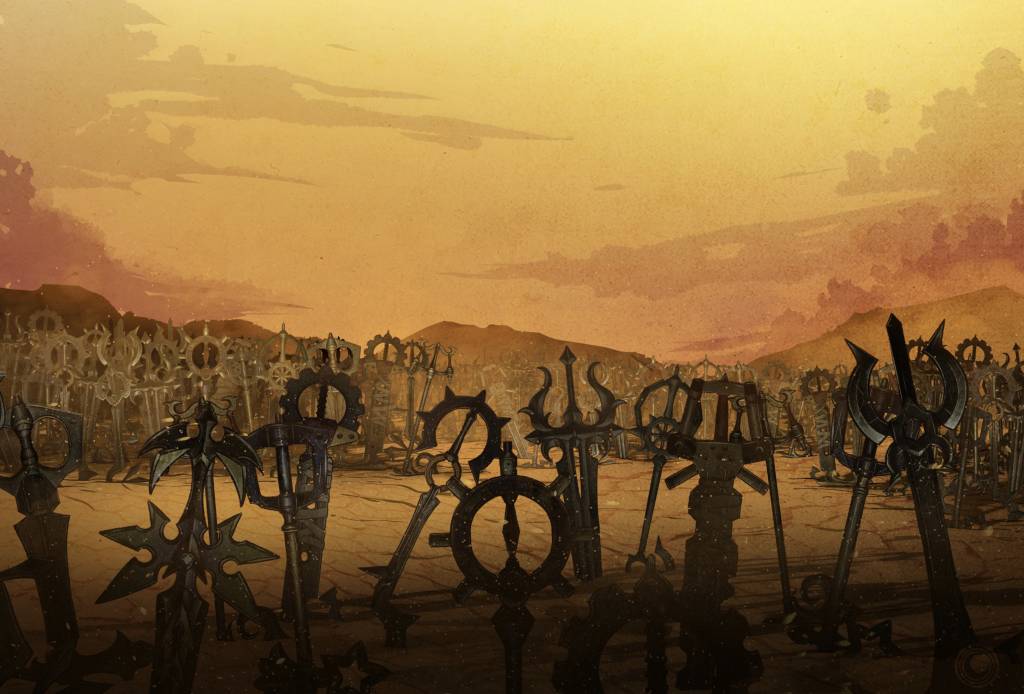
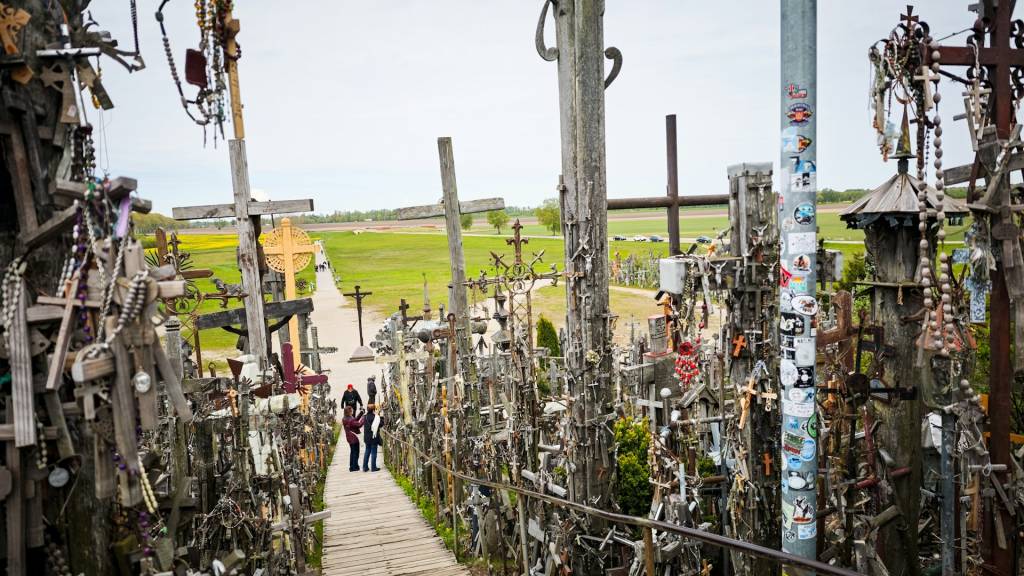
The resemblance is still worth noticing. The Hill of Crosses is a place shaped by suffering, memory, endurance, and faith, while the Keyblade Graveyard is a monument to conflict and destruction. In Kingdom Hearts III especially, that landscape becomes the setting for a decisive struggle over darkness, light, sacrifice, and the fate of those who have been lost. Whatever the artistic source, a field of key-shaped weapons standing like crosses over a graveyard naturally creates an image that Christian eyes will find difficult to ignore.
Where Kingdom Hearts remains only almost Christian
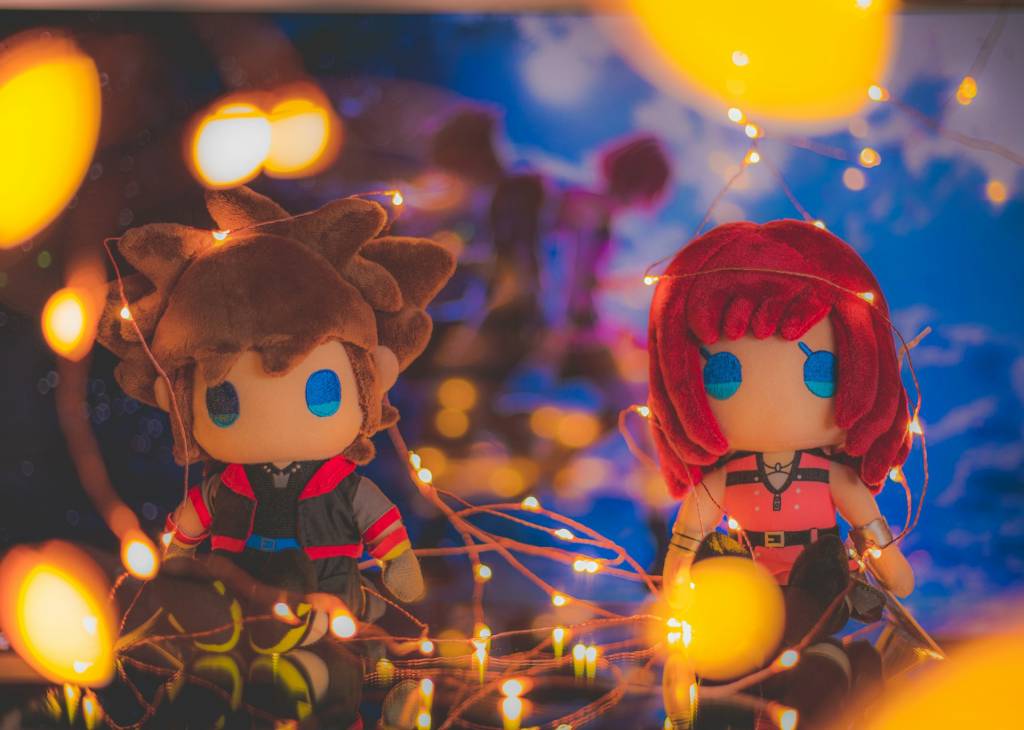
For all these parallels, Kingdom Hearts remains almost Christian rather than Christian. Its light is not the uncreated Light of God. Its darkness is not a complete account of sin and death. Its Kingdom Hearts is not the Kingdom of God, and its message about friendship cannot substitute for the Gospel.
This distinction matters because Christianity is not simply a collection of good themes. Sacrifice, friendship, redemption, light, and hope become fully Christian only when they are rooted in the living God. Orthodox Christianity does not merely teach us to choose generic light over generic darkness. It calls us to repentance, union with God, and a concrete life within the Church.
The games also sometimes suggest that darkness can simply be accepted as a permanent counterpart to light. Here the Orthodox Church must say something different. Good and evil are not two equal and necessary halves of reality. God is good, and everything He created is good by nature. Darkness is a distortion of that goodness, not its eternal partner.
That difference changes everything. The Christian goal is not to achieve a perfect balance between virtue and sin or between holiness and corruption. It is the healing and transformation of the human person by grace. The darkness within us is not something to enthrone beside the light, but something to expose, confess, heal, and overcome.
A heart turned inward or a heart opened in love
This may be the strongest Orthodox reading of the entire Kingdom Hearts series. A heart turned inward becomes vulnerable to darkness. Pride, fear, resentment, despair, and the desire for control slowly isolate the person from others. What begins as self-protection can end in spiritual imprisonment.
But a heart opened through sacrifice, fidelity, repentance, forgiveness, and love becomes capable of something else. Riku discovers that failure does not have to define him. Sora discovers again and again that strength is found through communion. Kairi and the other characters show that love continues reaching across distances that seem impossible to cross.
The Orthodox spiritual life is ultimately about the healing of the heart. We fast because our desires need healing. We confess because sin needs to be brought into the light. We pray because the heart was made for God. We receive the Eucharist because Christianity is not merely about thinking good thoughts but about communion with the living God.
Kingdom Hearts cannot give us that life. No video game can. But a good story can awaken a longing for something greater than itself, and sometimes a story can express truths it does not fully understand. That is what makes it worth paying attention to.
From the road to dawn into the life of the Church
After all the worlds, Heartless, Nobodies, Keyblades, time travel, memory loss, body swapping, replicas, dream worlds, and enough complicated lore to require several flowcharts, Kingdom Hearts keeps returning to something remarkably simple. The heart matters. Darkness is real. People can become lost. Sacrifice can restore what seems broken. And we need one another.
Those truths are almost Christian because Christianity takes them further than the games can. The Orthodox Church teaches that the human heart was created not merely for friendship but for communion with God. Darkness is not merely something to resist through inner strength, but a wound from which we need healing. Death is not simply a separation that love remembers across, but an enemy conquered through the Resurrection.
Perhaps that is why Kingdom Hearts has remained meaningful to me for so long. Beneath all its complexity is a story about hearts trying to find their way home. The historic Christian faith says that this longing is real, but our true home is not found by unlocking one final door. It is found by turning toward God and learning, within the life of the Church, to become what we were created to be.
So enjoy Kingdom Hearts. Let Riku remind you that repentance is always possible. Let Sora remind you that love gives itself away. Let the friendships remind you that nobody is meant to walk alone. Then allow those echoes of truth to point beyond the screen toward the fuller reality to which they can only gesture.
That is the purpose of Almost Christian: to look for fragments of truth in the stories our culture tells without confusing those fragments with the fullness of the faith. If there is a film, television series, video game, book, song, or other piece of media you would like me to cover in a future article, you can send your suggestion to me, Fr. Stephen, at frsteve@savannahorthodox.com.
Frequently Asked Questions About Kingdom Hearts and Christianity
Is Kingdom Hearts a Christian video game?
No. Kingdom Hearts is not a Christian game and should not be treated as a hidden presentation of Christian theology. It does, however, contain themes involving light, darkness, the heart, sacrifice, repentance, friendship, and restoration that can be meaningfully examined from an Orthodox Christian perspective.
Does Kingdom Hearts have Christian symbolism?
Some images in Kingdom Hearts can remind Christians of biblical themes, especially keys, light, darkness, sacrifice, and resurrection-like restoration. These similarities can make useful points of comparison, but they do not prove that the series was intentionally written as Christian symbolism.
What does darkness represent in Kingdom Hearts?
Across the series, darkness is closely connected with fear, anger, desire, pride, corruption, and the vulnerability of the heart. This resembles the Orthodox understanding of the passions in some interesting ways, although Christian teaching does not regard good and evil as equal forces that must remain in balance.
What can Christians learn from Riku in Kingdom Hearts?
Riku’s story offers a powerful picture of failure followed by repentance and restoration. He acknowledges the darkness into which he has fallen without allowing his past sins to become his permanent identity, which strongly echoes the Christian call to repentance.
Why is friendship so important in Kingdom Hearts?
Kingdom Hearts repeatedly presents isolation as destructive and communion as a source of strength. Orthodox Christianity takes this further by teaching that human beings were created for communion with God and one another, and that the Christian life is lived together within the Body of Christ.