Orthodox Christians are often asked why Orthodox Easter sometimes falls on a different day from Roman Catholic Easter or Protestant Easter. At first glance, that can seem like a small problem about calendars. In truth, it touches something much deeper in the life of the Church, because it has to do with how the Orthodox Church receives time, orders worship, and keeps the feast of Christ’s Resurrection.
The words Julian calendar and Gregorian calendar can sound technical, but the basic issue is simple. Different calendars reckon the year a little differently, and over time that changes how certain feast days are counted. Since Pascha is a movable feast connected to the spring equinox and the full moon, calendar differences affect how the date of Easter is determined.
Orthodox Christians believe Pascha is the Feast of Feasts, the center of the whole liturgical year. Saint Paul says, “if Christ has not been raised, then our preaching is in vain and your faith is in vain” (1 Corinthians 15:14). So when the Orthodox Church is careful about the dating of Easter, she is not being fussy. She is guarding the common worship of the Church around the saving truth that Christ is risen from the dead.
Julian and Gregorian Calendars and Why They Matter for Orthodox Easter
The Julian calendar was the calendar of the ancient Roman world and was used for many centuries by Christians. It was the calendar known in the time of the early Church, when the Gospel was preached, the martyrs suffered, and the great councils met. Because of that, it became closely tied to the liturgical life of Christians.
The Gregorian calendar was introduced in the West in 1582 as a reform of the Julian calendar. The Julian year is slightly longer than the true solar year, so over many centuries the dates slowly drifted. The Gregorian reform corrected that drift so that the civil date of the spring equinox would line up more closely with the sun’s actual course.
This matters because Easter is not a fixed feast like Christmas. It is a movable feast, which means its date changes from year to year. The calculation of Easter depends on the spring equinox and the paschal full moon, so when different calendars or different methods are used, different Easter dates can result.
For the Orthodox Church, however, this is not simply about picking between two civil calendars. Orthodox Christians believe the Church does not invent her life anew in every age. The Orthodox Church teaches that the worship of the Church is received, guarded, and handed down, especially in matters as central as the celebration of Christ’s Resurrection.
Why Orthodox Christians Often Celebrate Easter on a Different Day
The early Church cared deeply about unity in the celebration of Pascha. Christians did not think each place should decide Easter for itself according to preference. The First Ecumenical Council at Nicaea in AD 325 worked toward a common Paschal observance so that the Church could proclaim the Resurrection together in peace and good order.
The Council of Nicaea established the principle that Pascha should be celebrated in a unified way by the Church. It tied the feast to the spring equinox and the paschal full moon rather than leaving it to competing local customs. This mattered because the bishops understood that the Church is one Body, and her greatest feast should be kept together.
The Orthodox Church continues to use the ancient Paschalion, which is the traditional method of calculating Pascha. In that reckoning, the Church uses the Julian calendar for the ecclesiastical equinox and traditional lunar tables for the paschal full moon. Because of this, Orthodox Easter often falls later than Western Easter, though in some years the dates happen to coincide.
A point that often needs to be said clearly is that old calendar Orthodox and new calendar Orthodox do not normally have different Easters. Some Orthodox Churches use the Julian calendar for all feasts. Others use the Revised Julian or civil calendar for fixed feasts such as Christmas, but they still keep the traditional Orthodox Paschalion for Pascha. In ordinary Orthodox life, both old calendar and new calendar Orthodox celebrate the same Easter on the same day.
That distinction helps remove a lot of confusion. People sometimes hear the phrases old calendar and new calendar and assume there must be two Orthodox Easters. But the difference usually concerns fixed feasts, not Pascha. When Orthodox Christians gather for Holy Week and the Resurrection, they generally do so together in one Paschal celebration.
The Orthodox Church does not hold to this practice because she thinks newer things are automatically bad. Nor is the issue that the Gregorian calendar is somehow evil in itself. The real question is one of liturgical continuity. The Orthodox Church believes that the dating of Pascha belongs to the received life of the Church and should not be reshaped simply for convenience.
This is one reason Orthodox Christians speak of the Church as something received rather than invented. Doctrine, worship, fasting, and feast days belong together. The Orthodox Church teaches that faith is not only something written in books or argued in ideas. It is lived in prayer, in time, in the fasts and feasts, and in the shared rhythm of the Christian year.
Saint Paul says, “Let all things be done decently and in order” (1 Corinthians 14:40). That verse is not only about good manners in worship. It points to the deeper truth that the Church’s life is not chaotic or self-made. The celebration of Pascha belongs to that holy order, because the Resurrection stands at the very heart of Christian life.
Scripture also teaches us to see Christ as the fulfillment of the Passover. Saint Paul writes, “For Christ, our paschal lamb, has been sacrificed. Let us, therefore, celebrate the festival” (1 Corinthians 5:7-8). Orthodox Christians believe Pascha is not merely an anniversary. It is the yearly proclamation that Christ has conquered death and opened the tomb.
The Fathers of the Church treated this feast with the greatest seriousness and joy. Saint Athanasius sent Paschal letters to guide the faithful in keeping the feast rightly. Saint John Chrysostom’s Paschal homily is still read in Orthodox churches because it so beautifully declares the triumph of the risen Christ and calls all to rejoice in Him.
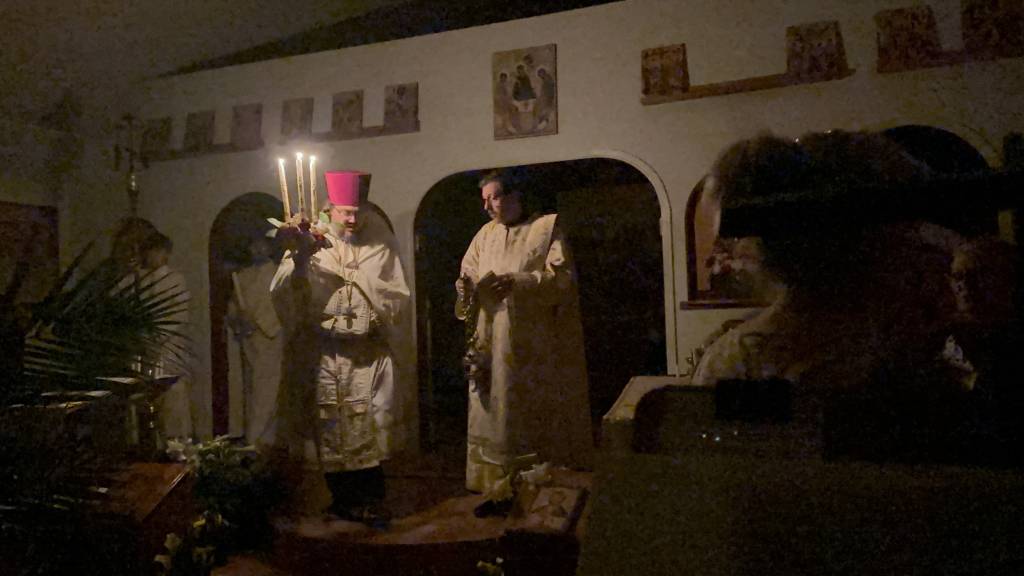
In practical terms, the date of Pascha shapes much of the Orthodox year. Great Lent, Holy Week, Ascension, and Pentecost all depend on it. This is why the question matters to ordinary Orthodox Christians. It affects when they fast, when they prepare, when they confess, and when they gather in the darkness of Pascha night to hear the words, “Christ is risen.”
There is also a quiet pastoral truth here. The Church does not keep time in a random way. Orthodox Christians believe Christ entered time in the Incarnation and sanctified time through His Cross and Resurrection. Because of that, the Church uses time to teach repentance, patience, expectation, and joy.
Sometimes people from outside Orthodoxy think the Church is simply behind the times. Others imagine this is only an ethnic habit or an old custom with no deeper meaning. But the Orthodox Church teaches that the issue is not nostalgia. It is fidelity. The Church keeps Pascha as she has received it because worship is not ours to reinvent.
Even so, this should never be explained with pride or harshness. A calm and pastoral explanation is better than a polemical one. Orthodox Christians believe the Church’s way is meaningful and faithful, but they should speak about it with peace, gratitude, and love.
The best way to understand all this is not only to read about it from a distance. Come and see. Come during Great Lent. Come during Holy Week. Come stand in the church when the light is passed from candle to candle and the Resurrection is proclaimed in the night. Then the question of calendars will no longer feel cold or technical, but part of the living rhythm of Orthodox Christianity, where Christ makes all things new.
Whether an Orthodox Christian belongs to an old calendar parish or a new calendar parish, he comes to the same risen Lord, the same empty tomb, and the same Paschal joy. That is worth remembering. Fixed feast days may differ in some places, but on Easter the Orthodox Church stands together and sings with one voice that Christ is risen.
In the end, the question is not just about how dates are counted. The deeper question is what the Church is and how she lives. The Orthodox answer is that the Church is the historic Body of Christ, receiving the faith from the apostles, preserving it through the councils and Fathers, and handing it on in worship. That is why the date of Pascha matters, and that is why the Orthodox Church continues to keep it as she does.
FAQ
Why is Orthodox Easter on a different date?
Orthodox Easter is often on a different date because the Orthodox Church uses the ancient Paschalion based on the Julian reckoning and traditional lunar tables. Western Christians usually use Gregorian calculations, which often produce a different Sunday.
Do old calendar and new calendar Orthodox celebrate the same Easter?
Yes. In the normal life of the Orthodox Church, old calendar and new calendar Orthodox celebrate the same Pascha because both follow the traditional Orthodox Paschalion for Easter. The difference usually affects fixed feasts, not the date of Pascha.
Do Orthodox Christians still use the Julian calendar?
Some Orthodox Churches use it for all feasts, while others use the Revised Julian calendar for fixed feasts. For Pascha, Orthodox Christians generally continue to follow the traditional Orthodox Paschalion.
Can Annunciation and Pascha ever fall on the same day?
Yes. It is called Kyriopascha. That is the rare coincidence when the Feast of the Annunciation and Pascha fall on the same day. It is especially loved in Orthodox tradition because it brings together the beginning of Christ’s earthly life in the womb of the Virgin and the victory of His Resurrection on one day.
Did the Council of Nicaea decide the date of Easter?
The Council of Nicaea established the principle of a unified Paschal celebration for the Church. The Orthodox Church sees her traditional practice as continuing that conciliar and historic rule.