With Halloween coming up next week, let’s get into the spirit of things with a movie that has become something of a classic in our house: Hocus Pocus. And by “classic,” I mostly mean that it is my wife’s favorite Halloween movie, so watching it every October is less a family tradition and more a condition of our marriage.
Halloween really can be good, clean fun if you allow it to be. You don’t have to turn it into something it isn’t, obsess over every decoration in the neighborhood, or spend the evening convinced that a plastic skeleton from Home Depot is somehow opening a portal to the demonic realm. Sometimes you can carve a pumpkin, let the kids dress up, eat entirely too much candy, and enjoy a ridiculous movie about three witches who burst into musical numbers.
And Hocus Pocus is exactly that kind of movie. You don’t need to sit down expecting a theological masterpiece. You’re supposed to have fun with it. But underneath all the jokes, witches, zombies, and talking cats, the movie stumbles into something profoundly Christian: the difference between taking life for yourself and being willing to give yourself for someone else. The Sanderson sisters will sacrifice anyone to keep themselves alive, while Max eventually becomes willing to sacrifice himself because he loves his sister. And right there, buried underneath all the hocus pocus, the movie gets surprisingly close to the heart of the Gospel.
Everyone Is Trying to Deal With Death
The basic story begins in Salem in 1693. The Sanderson sisters kidnap Emily Binx and use their magic to steal her life so that they can remain young. Emily’s brother, Thackery Binx, tries to rescue her but fails, and the sisters curse him to live forever as a black cat. Three hundred years later, Max Dennison accidentally brings the witches back, and Max, his sister Dani, Allison, and Binx spend Halloween night trying to stop them from doing the same thing to the children of Salem.
That means death is hanging over nearly every part of the story. The Sanderson sisters desperately want to escape it. Binx desperately wants release from an unnatural life that never ends. Max eventually finds himself willing to face death for someone he loves. The movie is a comedy, but the question underneath the comedy is serious: What does it actually mean to live when we know that we are going to die?
That question is deeply Christian. Hebrews 2:14-15 says that Christ shared in our humanity so that through death He might destroy the one who had the power of death and deliver those who were held in lifelong bondage by its fear. The Orthodox Church does not treat death as natural, harmless, or merely another stage of life. Death is an enemy, a rupture in the human person, and something humanity cannot finally defeat by its own power.
The Sanderson sisters understand one part of the problem. They know death is coming, and they are terrified of it. Their answer, however, is completely backwards. They try to save themselves from death by taking life from someone else.
You Must Die So That I Can Live
This is where Hocus Pocus comes closest to giving us an inverted picture of Christianity. The witches’ continued youth depends upon consuming the lives of children. Their approach could almost be summarized this way: You must die so that I can live. Christian love moves in precisely the opposite direction: I will give myself so that you may live.
That contrast takes us straight to the Cross. Jesus Christ does not preserve Himself at our expense. He voluntarily enters suffering and death for the life of the world. As the Lord says in John 15:13, “Greater love has no man than this, that a man lay down his life for his friends.” The Cross reveals love not as an emotion we feel but as the giving of oneself for another.
The Sanderson sisters are incapable of that kind of love because everything ultimately turns inward. They want youth, beauty, power, revenge, attention, and survival. Even their relationship with one another exists within this larger obsession with getting what they desire. In Orthodox Christianity, we would recognize much of this as the work of the passions: good human desires that have become disordered and now rule the person rather than serving their proper purpose.
The passions promise life but make us slaves.
The witches are exaggerated characters, but the spiritual principle is not exaggerated at all. Most of us will never brew a potion to steal somebody’s youth, but we know what it means to be controlled by appetite. We can become ruled by money, sex, anger, food, approval, entertainment, comfort, status, or the desperate need to have things our own way.
The problem is not that desire itself is evil. The Orthodox Church teaches that the human person was created good, including our capacity to desire. The problem comes when desire is separated from God and begins governing us. Asceticism, fasting, prayer, and repentance are therefore not about learning to hate the world; they are part of learning how to desire rightly again.
The Sanderson sisters never reach that point. They do not ask whether their desires are good. They simply assume that because they want something badly enough, they should have it. Everyone around them becomes either a tool for satisfying those desires or an obstacle to be removed.
Living forever is not the same thing as salvation.
Then there is Binx. In a strange way, he gets exactly what human beings have spent centuries dreaming about. He cannot die. Three hundred years pass, generations come and go, and Binx remains.
But the movie understands something important: this is not salvation. It is a curse. Binx does not want an endless extension of his present existence. He wants to be free from the curse and reunited with the sister he lost.
Orthodox Christians believe in eternal life, but eternal life does not simply mean stretching our present biological existence across an infinite timeline. Christianity proclaims resurrection. God intends to redeem the whole human person, body and soul, and restore creation from the corruption of death. That is why the Nicene Creed ends with the confession, “I look for the resurrection of the dead, and the life of the world to come.”
There is an enormous difference between never dying and being raised from the dead. Christianity does not promise that we will remain forever exactly as we are now, complete with every wound, passion, weakness, disease, and consequence of the Fall. The hope of the Church is transformation and communion with God.
Knowing the supernatural exists is not the same as knowing God.
Of course, Hocus Pocus is full of witches, spells, curses, magic books, zombies, and other supernatural things. This is where Christians can sometimes go in one of two unhelpful directions. We either treat all of it as completely meaningless, or we become so fascinated and frightened by fictional depictions of magic that we begin acting as though watching a Halloween comedy is itself a spiritual event.
The Orthodox Church takes spiritual evil seriously. The Scriptures do too. But taking evil seriously is not the same thing as becoming superstitious or obsessed with it. A Christian should be far more concerned about his own anger, lust, pride, greed, resentment, and neglect of prayer than about the plastic witch hanging from his neighbor’s porch.
Even genuine supernatural power would not prove holiness. Pharaoh’s magicians performed signs. Simon Magus desired spiritual power for the wrong reasons. St. James reminds us that even the demons believe in God and tremble. Christianity is not the belief that invisible things exist; it is communion with the living God.
That is also why Halloween does not need to become a yearly panic. Parents should certainly use judgment about what their children watch and participate in, just as they should every other day of the year. But dressing up, carving pumpkins, handing out candy, and watching Hocus Pocus do not need to become something larger than they are. Enjoy the evening, use common sense, and spend more time fighting your actual sins than imaginary ones.
Max learns that reality is bigger than his assumptions.
At the beginning of the movie, Max is the skeptic. He thinks the local stories are ridiculous, and he is confident enough in that judgment to light the Black Flame Candle. Then the Sanderson sisters appear, and suddenly Max discovers that reality does not care very much about what he previously considered plausible.
There is a useful lesson here without turning Max into a stand-in for every atheist or skeptic. Human beings have a habit of assuming that what we cannot imagine cannot be true. But reality is under no obligation to fit comfortably inside our expectations. Christianity asks us to approach reality with humility rather than making our own experience the final measure of what can exist.
Faith does not mean believing something merely because it is strange or supernatural. The Church has always warned Christians against deception, superstition, and fascination with signs. But neither should we assume that modern people have finally discovered all the boundaries of reality. Humility leaves room for us to discover that we were wrong.
Yes, the virgin joke is very 1993.
There is also the running joke about Max being a virgin. The movie repeatedly treats his virginity as something embarrassing, which is such a perfectly 1990s movie joke that it almost deserves to be preserved in a museum. It also reveals something about the difference between Christian and secular understandings of sexuality.
The historic Church does not see chastity as evidence that someone has failed to live. Sexuality is powerful precisely because it means something. Orthodox Christianity places sexual intimacy within marriage not because the body is dirty, but because the body matters and sexual union involves the whole person.
This is not the central message of Hocus Pocus, and it does not need to become the central point of our discussion either. Still, it is worth noticing how easily popular culture can turn self-control into a punchline. Christianity instead sees chastity as freedom: our desires are part of us, but they do not have to rule us.
Max begins to understand sacrificial love.
The most important change in the story happens in Max himself. Early in the film, he is annoyed by his younger sister, eager to impress Allison, and generally occupied with his own concerns. Dani is his responsibility largely because his parents have made her his responsibility.
By the climax, something has changed. When Dani is in danger, Max is willing to offer himself in her place. The boy who spent much of the movie thinking about himself becomes willing to lose himself for someone he loves.
This is where Hocus Pocus becomes “almost Christian” in the strongest sense. Max’s sacrifice is not the Gospel, and we should not force every movie sacrifice into an allegory of the Cross. But it reflects something true about love: love reaches maturity when it becomes self-giving.
The Christian claim goes much further. Christ does not give Himself only for family or friends who have earned His affection. Romans 5 teaches that He gives Himself while humanity is still trapped in sin. Christian love therefore reaches even toward enemies, strangers, and people who cannot repay us.
Dani cannot rescue herself.
There is another detail worth noticing in the final confrontation. Dani is in a situation she cannot simply fix through greater effort. Someone else must act on her behalf. Max steps into that danger because he loves her.
We should be careful not to turn Dani into a complete theory of salvation. Still, Christianity begins with the recognition that humanity cannot cure death and corruption by trying harder. Salvation is not a self-improvement project in which sufficiently disciplined people eventually climb their way to God.
The Orthodox Church teaches salvation as participation in the life of God, made possible because God first acts toward us. We respond freely through faith, repentance, baptism, prayer, the Eucharist, obedience, and the whole sacramental life of the Church. Grace does not eliminate our response, but our response is possible because God has already come seeking us.
Binx finally receives what he actually wanted.
The emotional conclusion belongs to Binx. After three hundred years trapped in the form of a cat, the curse is finally broken. His long existence ends, and the film depicts him reunited with Emily.
It is sentimental, but it recognizes something true. Simply continuing to exist was never enough for Binx. What he wanted was communion. He wanted the relationship death had torn away from him to be restored.
Christianity takes that longing much further than the movie can. Our hope is not that we become glowing spirits who walk beautifully into the distance with people we miss. The Christian hope is resurrection, the restoration of the human person, and eternal communion with God in a creation made new.
This is why Christians can grieve without treating death as the final word. We do not pretend death is good. We bury those we love, mourn them, commemorate them, and pray for them precisely because love does not become meaningless at the grave. Death remains an enemy, but it is a defeated enemy.
The witches fear death, but Christianity proclaims its defeat.
The Sanderson sisters spend the entire movie trying desperately not to die. Binx spends centuries discovering that merely avoiding death is not enough. Max reaches the point where he is willing to face death for another person. Those three responses give us a surprisingly useful picture of the questions human beings have always asked about mortality.
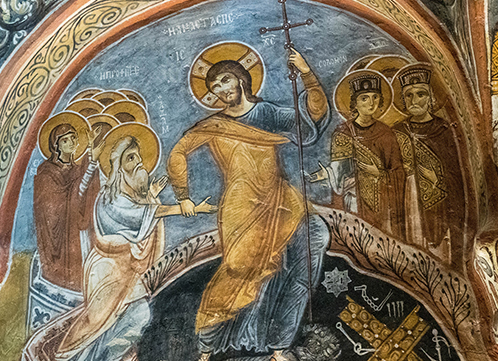
The Christian answer is different from all three. The goal of the spiritual life is not to preserve ourselves indefinitely. It is union with the One who has conquered death. Jesus Christ enters the grave and transforms it from within, which is why the central proclamation of Orthodox Pascha is that Christ is risen from the dead, trampling down death by death.
That does not mean Christians stop feeling afraid or stop grieving. Even our Lord wept at the tomb of Lazarus. Christianity does not ask us to pretend death is painless; it gives us a reason why death does not get the final word.
This is also why the Resurrection is not an optional extra added onto Christian teaching. St. Paul says plainly in 1 Corinthians 15 that if Christ has not been raised, our faith is futile. Christianity stands or falls with the proclamation that death itself has been invaded and defeated.
That is what makes Hocus Pocus almost Christian.
Hocus Pocus is not secretly an Orthodox movie. The Sanderson sisters are not carefully constructed symbols of the passions, Binx is not teaching a patristic theology of resurrection, and Max is not supposed to be a figure of Christ. It is a funny Halloween movie made to entertain people, and we should allow it to be exactly that.
But stories often reveal truths their creators are not deliberately trying to preach. Hocus Pocus understands that endless self-preservation is empty, that unchecked desire becomes slavery, that love requires sacrifice, and that merely avoiding death cannot satisfy the deepest longing of the human heart. Those are fragments of something much larger.
That is the point of this Almost Christian series. Popular culture can sometimes get surprisingly close to Christian truth because human beings continue asking the same questions about love, suffering, death, sacrifice, forgiveness, and hope. But an echo is not the voice itself, and a fragment is not the whole.
The fullness is found not in a movie but in the life of the Church. It is encountered in repentance, prayer, baptism, confession, the Eucharist, the Scriptures, the communion of the saints, and ultimately in the risen Lord Himself. Orthodox Christians do not merely believe that death can somehow be escaped. We confess that death has been conquered.
So carve the pumpkin. Hand out the candy. Put on Hocus Pocus for the hundredth time because apparently your marriage depends upon it. Enjoy Halloween without turning it into either a pagan apocalypse or a theological seminar.
But when the movie is over, remember the truth it can only approach from a distance. The answer to death is not desperately taking more life for ourselves. The answer is the self-giving love of God, the Cross, and the empty tomb. The Sanderson sisters want to live forever, but the Church proclaims something infinitely better: resurrection.
Frequently Asked Questions
Is Hocus Pocus a Christian movie?
No. Hocus Pocus is a Halloween fantasy comedy, not a Christian film. However, its themes of death, self-sacrifice, disordered desire, and love can provide useful starting points for discussing Christian teaching.
Can Orthodox Christians watch Hocus Pocus?
The Orthodox Church does not provide a list of approved secular movies. Christians should use discernment about entertainment, especially according to age and individual spiritual struggles, without turning entertainment choices into superstition.
Can Orthodox Christians celebrate Halloween?
Orthodox Christians should avoid occult practices and anything that genuinely conflicts with the Christian life. Ordinary activities such as costumes, pumpkins, candy, neighborhood gatherings, and age-appropriate movies need not be treated as participation in the occult simply because they happen on Halloween.
What does Orthodox Christianity teach about death?
The Orthodox Church teaches that death is an enemy resulting from humanity’s fallen condition, not the final destiny God intended for mankind. The Christian hope is the resurrection of the dead and eternal communion with God, not merely the endless survival of the soul.
Why is sacrifice important in Christianity?
Christian love is self-giving rather than self-centered. The Cross reveals this most completely, and Christians are called to learn that same love by giving themselves to God and neighbor rather than making others serve their passions.
If you have a movie, television show, book, song, or other piece of popular culture you would like to see covered in Almost Christian, you can send your suggestion to Fr. Stephen at frsteve@savannahorthodox.com.