Learning how to act in an Orthodox church can feel awkward at first. There are crosses, bows, candles, icons, blessings, processions, incense, standing, sitting, and movements that may seem unfamiliar. That is normal. No one is expected to know everything the first time they walk in. The important thing is to learn with humility, patience, and a willingness to be taught.
In the Orthodox Church, these actions are not empty customs. They are ways the body joins the soul in prayer. We cross ourselves because the Cross is our salvation. We bow because we stand before God. We venerate icons because Christ truly became man and His saints are alive in Him. We receive blessings because the Church is not a private spiritual project, but a life received through Christ and His Body. These small actions teach us how to live reverently before God.
Praying with the Body
How to cross yourself.
Orthodox Christians make the sign of the cross with the right hand. The thumb, index finger, and middle finger are brought together to confess the Holy Trinity: Father, Son, and Holy Spirit. The ring finger and little finger are folded down to remind us of the two natures of Christ: fully God and fully man. Then we touch the forehead, the abdomen/stomach, the right shoulder, and the left shoulder. In the Orthodox Church, we cross ourselves from right to left.
The sign of the cross is not magic. It is prayer. When we cross ourselves, we confess with our body what we believe in our heart: that Jesus Christ has saved us through His Cross and Resurrection. The Cross was once an instrument of death, but Christ turned it into the sign of victory, forgiveness, and eternal life.
We make the sign of the cross because the Christian faith is not only something we think about. It is something we live with our whole person, body and soul together. The body also learns to pray. The body also learns to repent. The body also learns to remember Jesus Christ.
That is why we cross ourselves when entering the church, before and after prayer, when the Holy Trinity is named, when venerating icons, when receiving a blessing, during important moments in the services, and whenever we need to remember Christ. We are placing ourselves under the Cross of the Lord and asking Him to sanctify our thoughts, our desires, our actions, and our whole life.
Saint Paul says, “God forbid that I should boast except in the cross of our Lord Jesus Christ” (Galatians 6:14). The sign of the cross teaches the body to boast in nothing else. It reminds us that our hope is not in our strength, our feelings, or our own righteousness, but in Christ crucified and risen.
Bowing during the services.
Bowing is a simple act of reverence. We bow because we are standing before God, not attending a religious performance. A bow says with the body what the heart should be saying: “Lord, have mercy on me.” Sometimes we make a small bow from the waist. Sometimes we bow while making the sign of the cross. The exact practice can vary slightly from parish to parish, but the spirit is the same.
One common time to bow is when the priest or deacon censes the people. Incense is offered to God, and it also honors the image of God in the faithful. When the clergy cense you, they are not praising you as an individual. They are honoring Christ’s image in you and the grace of God in the Church. It is normal to bow slightly when you are censed, acknowledging this blessing and returning reverence.
Prostrations before God.
A prostration is a deeper bow in which we go down to the ground, usually touching the floor with the hands and forehead, and then rise again. Prostrations express repentance, humility, and worship before God. They are especially common during Great Lent and certain penitential services. When we prostrate, we are not performing for others. We are placing ourselves before the mercy of God.
Prostrations are not usually done on Sundays or during the Paschal season, because Sunday is the day of Resurrection and Pascha is the feast of victory. The Church teaches us that even bodily posture has meaning. There is a time to bow low in repentance, and there is a time to stand in the joy of the Resurrection. If you are physically unable to prostrate, do not be embarrassed. Bow as you are able. The goal is humility, not injury.
Standing, sitting, and moving reverently in church.
Orthodox Christians stand a great deal during the services because standing is a posture of prayer, attention, and resurrection. We are not an audience watching a performance. We are the people of God standing before the Lord. At the same time, sitting is not forbidden. If you are tired, pregnant, elderly, sick, injured, holding a child, or simply need to sit, please sit. The Church is not asking you to prove how tough you are.
As a general rule, do your best to stand during the Gospel reading, the Creed, the Lord’s Prayer, and the Anaphora prayers, which are the central Eucharistic prayers of the Divine Liturgy. These moments deserve special attention. If you need to move during a service, move quietly and carefully. Try not to walk around during the Gospel reading, the Great Entrance, the Creed, the Anaphora, or Holy Communion unless there is a real need. Reverence is not stiffness. It is attention to God and care for those praying around you.
Venerating icons.
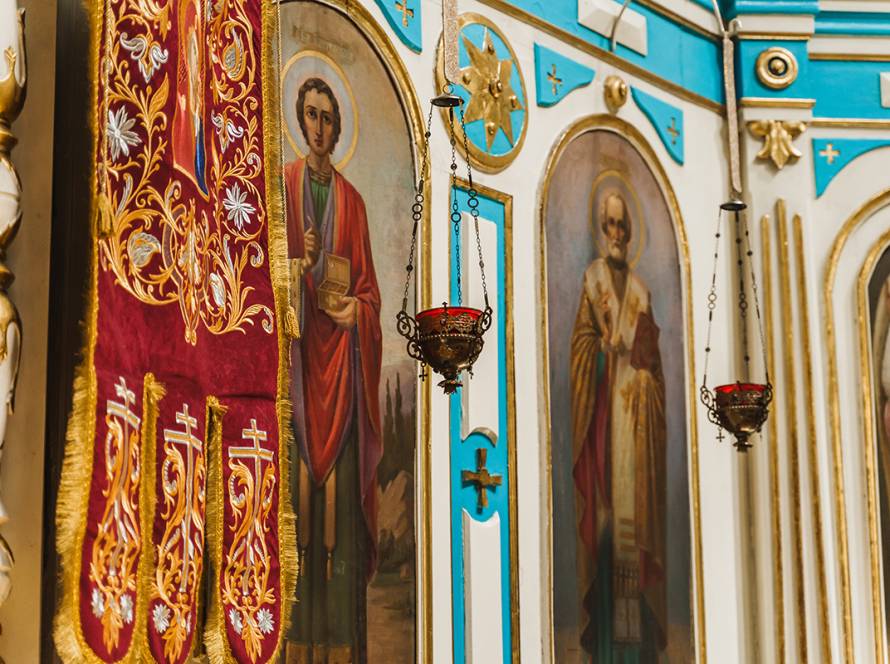
When entering the church, Orthodox Christians normally venerate the icons. A simple way to do this is to make the sign of the cross, bow, kiss the icon, and make the sign of the cross again. Usually we kiss the hand, feet, garment, or edge of the icon rather than the face. This is an act of love and reverence, not worship of wood and paint.
Icons are holy images of Christ, the Theotokos, the angels, the saints, and the feasts of the Church. We venerate them because the honor given to the image passes to the person depicted. Worship belongs to God alone. If you are wearing lipstick, please be careful not to leave lipstick on the icon. This is not about embarrassment. It is simply care for holy things and for the next person who will venerate the icon.
Blessings, Communion, and Holy Things
Receiving a blessing from a priest.
To receive a blessing from a priest, place your hands together, right hand over left, palms upward. You may say, “Father, bless.” The priest will bless you with the sign of the cross and place his hand in your hands. You then kiss his hand, not because the priest is personally impressive, but because that hand blesses, offers the Holy Gifts, baptizes, anoints, and serves Christ’s Church.
Receiving a blessing teaches humility. It reminds us that the Christian life is received, not invented. We do not bless ourselves into the Church. Christ blesses His people through the ministry of the Church. A priest’s blessing is not magic, but it is real. It is a prayer of the Church given through the priestly ministry.
When a bishop is present, you do not go to the priest for a blessing. You receive the blessing from the bishop. The bishop is the chief shepherd of the local Church, and the priest serves under his blessing. This is not a matter of personal preference or politeness only. It reflects the order of the Church.
Approaching during Holy Communion.
Holy Communion is the true Body and Blood of Christ. Only Orthodox Christians who are prepared and blessed to receive may receive Communion. Catechumens do not receive Holy Communion yet. They are preparing to be united to the Church through baptism and/or chrismation, and then to receive the Holy Mysteries as members of the Church.
In our parish, catechumens come forward during Communion to receive a blessing, but they do not receive the Eucharist. Not every parish does this. Many parishes in the Diocese of the South do, but other dioceses and jurisdictions may not. If you are visiting another Orthodox parish, do not assume the local practice. Ask quietly beforehand, or simply remain in place and follow what the priest or catechist has instructed.
When Orthodox Christians approach for Communion, they do so with reverence, arms crossed over the chest, stating their baptismal name clearly if needed. They do not reach for the chalice or spoon. They receive what is given. After receiving, they carefully wipe their lips if the cloth is offered and then receive blessed bread and sometimes wine or warm water, depending on the parish tradition.
Blessed bread, antidoron, and zapivka.
Antidoron is blessed bread given after the Divine Liturgy. It is not Holy Communion. The word means “instead of the Gifts.” It is often received by Orthodox Christians after Communion, and it may also be given to those who did not receive Communion, including catechumens and visitors, depending on local practice. It is blessed, so it should be received respectfully and not treated casually.
Zapivka is the wine, or wine mixed with warm water, and sometimes additional blessed bread received after Communion in some Orthodox traditions. It is also not Communion. It is used to help those who have fasted from food and drink before receiving, especially because the Eucharistic portion is small. It also helps ensure the Holy Gifts are consumed carefully. Practices vary by parish and jurisdiction, so follow the local custom without making a fuss.
Lighting candles and offering prayers.
Lighting candles is a simple and beautiful act of prayer. We light candles before icons as a sign of our prayer rising to God. The candle reminds us of Christ, the Light of the world, and of our desire to offer our lives to Him. We may light candles for ourselves, for family, for friends, for the sick, for those in trouble, and for the departed.
When lighting a candle, do it quietly and prayerfully. You might pray, “Lord, have mercy on Thy servant,” and name the person. We remember both the living and the departed because the Church is not divided by death. Those who have departed this life are still alive before God, and we continue to love them through prayer.
Handling blessed items properly.
Blessed items should be treated with reverence. This includes blessed bread, holy water, palms, candles, icons, prayer ropes, crosses, vestments, service books, and other items connected to worship. We do not treat blessed things like ordinary trash. They have been set apart for holy use.
If you need to dispose of something blessed, ask the priest. In general, blessed items are burned or buried in a clean place where they will not be trampled. This is why old vestments, damaged icons, palms, and similar items are often burned rather than thrown away. If blessed bread falls, pick it up and consume it if possible. If something spills or is mishandled, do not panic. Be reverent, ask for help, and learn.
Living Reverently in the Parish and at Home
Asking forgiveness and greeting others.
Orthodox life is not only about private prayer and proper movements in church. It is also about learning to love people. We ask forgiveness because we sin against one another. We greet one another because the Church is a family in Christ, not a room full of strangers attending the same religious event.
Before receiving Holy Communion, Orthodox Christians should be at peace with others as much as possible. Christ says, “If you bring your gift to the altar, and there remember that your brother has something against you… first be reconciled to your brother” (Matthew 5:23-24). This does not mean every conflict will be perfectly solved before every Liturgy, but it does mean we should not cling to hatred, bitterness, or pride.
How to address clergy and clergy wives.
Priests are usually addressed as “Father” followed by their first name. Deacons are addressed as “Father Deacon” or “Deacon,” depending on local custom. Bishops are addressed with titles such as “Your Grace,” “Your Eminence,” or “Master,” depending on rank and tradition. If you are unsure, ask. No one should be offended by a sincere question.
Priests’ wives are also addressed with respect. In many Slavic and OCA parishes, a priest’s wife may be called Matushka. In Greek parishes, she may be called Presbytera or Presbyteria. Other Orthodox jurisdictions and ethnic traditions have their own names as well. These titles do not mean she is ordained or has the priesthood. They recognize her place in the life of the parish and the sacrifice that often comes with sharing in her husband’s ministry.
Teaching children reverence in church.
Children belong in church. They are not interruptions to the life of the Church. Christ says, “Let the little children come to Me” (Matthew 19:14). Children learn by being present, seeing adults pray, hearing the hymns, venerating icons, lighting candles, and receiving blessings. They will not understand everything at once, and that is fine.
At the same time, children need guidance. Teach them to cross themselves, kiss icons, whisper when necessary, stand for short portions of the service, and move carefully. If a child needs a break, take the child out quietly and return when possible. Do not be embarrassed by normal childhood noise, but also do not let children treat the nave like a playground. Reverence is learned slowly, with patience and consistency.
Having icons, crosses, prayer ropes, cars, houses, and other things blessed.
Orthodox Christians often ask the priest to bless icons, crosses, prayer ropes, homes, cars, and other things used in daily life. This is a good and normal practice. We do this because we want our whole life to belong to God. The Christian life is not limited to Sunday morning. Our homes, travel, work, possessions, and daily routines should be offered to Christ.
Do not hesitate to ask for these blessings. If you have a new icon, bring it to church and ask the priest to bless it. If you move into a home, ask for a house blessing. If you have a car, especially one used daily or for family travel, ask for it to be blessed. These blessings are not superstition. They are prayers asking God to sanctify our life and protect us as we seek to live faithfully.
Learning local parish customs with humility.
Not every Orthodox parish does every practical thing in exactly the same way. Some customs vary by diocese, jurisdiction, ethnicity, monastery influence, and local parish practice. One parish may have catechumens come forward for a blessing during Communion. Another may not. One parish may use zapivka. Another may not. One parish may sit more. Another may stand more. These differences should not trouble you.
The safest approach is simple: watch, ask, and do not make a scene. If you are unsure what to do, ask your priest, catechist, sponsor, or a trusted parishioner. Do not turn small practical customs into major spiritual anxieties. Learn slowly. The point of all these actions is not to become self-conscious. The point is to become reverent.
Saint Paul teaches that all things in the Church should be done “decently and in order” (1 Corinthians 14:40). That order is not meant to make the Church stiff or cold. It helps us worship together. When we learn how to cross ourselves, bow, receive blessings, venerate icons, light candles, and move reverently, we are learning how to live as members of the Body of Christ.
Most Commonly Asked Questions
What if I do something wrong in church?
Do not panic. Everyone had to learn at some point. If you make a mistake, correct it quietly and keep praying. It is better to be humble and attentive than to be so worried about doing everything perfectly that you stop praying.
When should I stand during the service?
As much as you are able, stand during the Gospel reading, the Creed, the Lord’s Prayer, and the Anaphora prayers. Many Orthodox Christians stand for most of the service, but if you are tired, sick, pregnant, elderly, holding a child, or in pain, please sit. Reverence includes wisdom.
Can catechumens go forward during Communion?
In our parish, catechumens come forward to receive a blessing during Communion, but they do not receive Holy Communion. Many parishes in our diocese do this, but not every Orthodox parish does. If you are visiting elsewhere, ask first or follow the local instruction.
What should I do with blessed items I cannot keep?
Do not throw blessed items in the trash. Ask the priest what to do. Usually blessed items are burned or buried in a clean place where they will not be trampled. This shows reverence for things set apart for holy use.
What should I do next?
Start with the basics. Learn to cross yourself, venerate icons, receive a blessing, stand reverently, light candles, and ask questions when you are unsure. Do not try to master everything at once. Come to the services, watch carefully, and learn with humility.
A Pastoral Closing
These practical actions may seem small, but they help train the whole person in reverence. Orthodoxy is not only something we think about. It is something we live with the body, soul, heart, and mind. Cross yourself carefully. Bow humbly. Receive blessings with gratitude. Treat holy things with reverence. Teach your children patiently. Ask when you do not know. Over time, these practices stop feeling strange and begin to feel like home.
If you’re working through this and need guidance, reach out to Fr. Stephen at frsteve@savannahorthodox.com AND Anthony at anthony@anthonyally.com. CC us both.