


Why a Bishop’s Visit Matters

In the life of the Orthodox Church, the visit of a bishop is never merely ceremonial. It is not the arrival of a guest speaker, an administrator, or an honored dignitary. When a bishop comes to a parish, the Church herself is made visible in a unique and concrete way. The bishop is the successor of the Apostles, the visible sign of unity, and the one who presides in love over the local Church. His presence reminds us that no parish exists in isolation, but always as part of the one, holy, catholic, and apostolic Church.
Because bishops do not visit every parish frequently, their arrival can sometimes feel unfamiliar or even intimidating, especially for newer parishioners, catechumens, or inquirers. This article is meant to be something you can return to again and again. Whether you have been Orthodox for decades or are visiting an Orthodox church for the first time, understanding what a bishop’s visit means and how to prepare for it can transform the experience from something awkward into something deeply joyful.
That said, in Orthodox Christianity, the bishop is not a regional manager or a distant authority figure. He is the chief shepherd of the local Church, entrusted with guarding the faith, ordaining clergy, and preserving unity by Jesus Christ, who is our only head and He chooses to have himself represented unto us via his Apostles and Bishops. Every parish priest serves with the blessing of his bishop, and every Divine Liturgy is offered in communion with him, whether the bishop is physically present or not. The life of the parish is never independent of the bishop, even on an ordinary Sunday when he is not standing in the храм.
This is why the services themselves still assume the presence of the bishop. When you hear the deacon address the priest as “Master,” it is not simply a polite title or a remnant of old language. It reflects the Church’s understanding that the priest is serving in the place of the bishop and with his authority. The structure of the liturgy continues to reflect the ancient reality that the Eucharist belongs to the bishop, even when it is celebrated locally by a priest.
Historically, the bishop presided at every Eucharistic gathering in a city, and the priest assisted him. While that is no longer practical in modern dioceses spread across wide geographic areas, the theology has never changed. The bishop remains present in the life of the parish through the priest who serves with his blessing and in obedience to him. When the bishop is physically present, that ongoing reality becomes visible in a fuller and more tangible way.
His presence reminds us that the faith we live in our parish is not a local variation or a private expression of Christianity. It is the same faith lived across the world and across the centuries, rooted in apostolic continuity, unity, and communion with the shepherd entrusted with the care of the local Church.
The most important preparation for a bishop’s visit is not logistical but spiritual. This is a moment to cultivate gratitude rather than anxiety.
The most important preparation for a bishop’s visit is not logistical but spiritual. While schedules, seating, and coordination matter, they are secondary. This is a moment to cultivate gratitude rather than anxiety, attention rather than performance. A bishop’s visit is not something to get through correctly, but something to receive prayerfully.
In the days leading up to the visit, make a conscious effort to slow down and prepare your heart. Spend time in personal prayer, even if only briefly, asking God to help you be present and attentive. Pray for the bishop, who carries the weight of pastoral responsibility for many parishes and clergy. Pray for the priests and deacons who will serve with him, for the choir and altar servers, and for the parish as a whole.
It can also be helpful to pray for yourself, asking God to remove distractions, nervousness, or the feeling that you need to “do everything right.” Ask God to help you receive the visit not as a performance to observe or evaluate, but as a gift to enter into. When the heart is prepared in this way, the visit becomes less about ceremony and more about blessing, communion, and shared prayer in the life of the Church.
What Will Be Different During the Services?
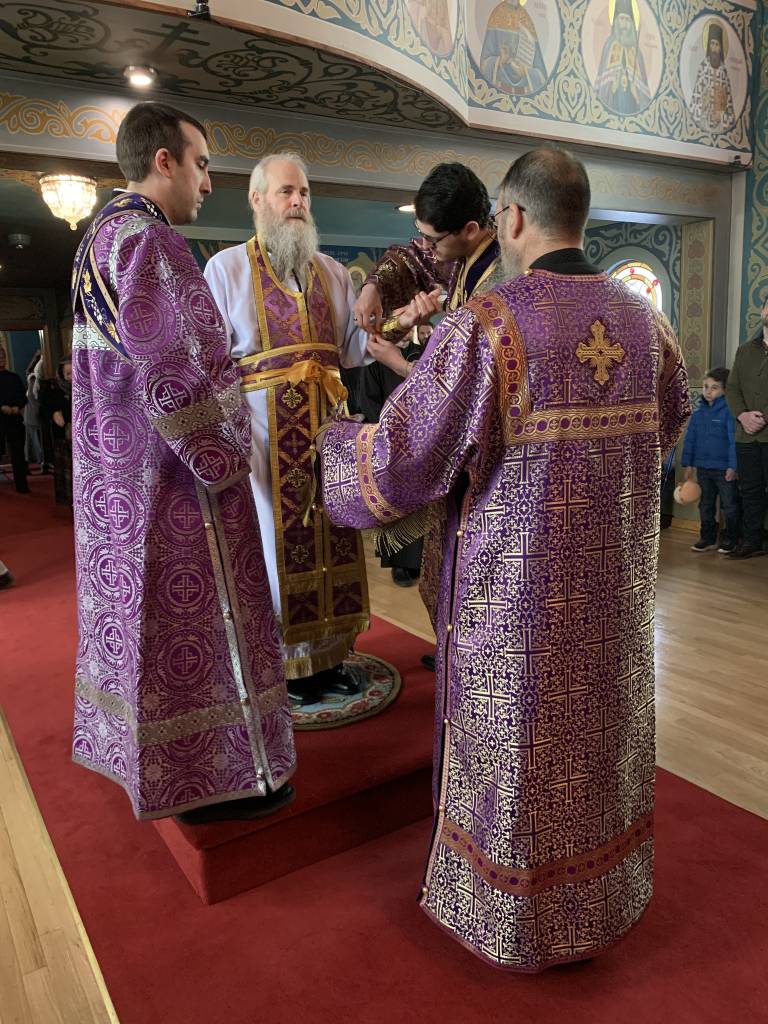
When a bishop serves, the Divine Liturgy will usually be longer and more elaborate. There may be additional clergy present, more chanting, and ceremonial elements that you do not normally see on a Sunday.
You may notice:
• The bishop blessing the people frequently
• The clergy addressing the bishop aloud during the service
• The bishop seated at certain moments rather than standing throughout
All of this can feel unfamiliar at first, especially if you have never experienced a bishop serving in your parish. The good news is that none of it requires special knowledge or preparation from the congregation. In fact, the simplest approach is the best one. Pray, listen, and follow along as you normally would.
Here are few basic guidelines can help you feel more at ease and receive the visit with peace rather than uncertainty:
How Should You Greet the Bishop?
One of the most common questions parishioners ask is how to greet a bishop properly. The simplest answer is this: do not be afraid.
If you are introduced to the bishop or approach him, you may say, “Your Grace” or “Vladyka,” depending on local custom. You may receive his blessing by bowing slightly and kissing his hand, just as you would with a priest. If you are unsure, simply follow the example of others or greet him respectfully without anxiety. Bishops are pastors. They expect to meet people who are nervous, unsure, or new to the Church. Courtesy, humility, and sincerity matter far more than perfect etiquette.
What About Children?
Children should be encouraged to participate naturally during a bishop’s visit, just as they do on any other Sunday. Let them come forward for the bishop’s blessing, let them watch, listen, and ask questions, and do not worry if they are shy, curious, or a little restless. The Church has never expected children to behave like miniature adults.
Metropolitan Anthony Bloom once spoke about children in church as being a kind of holy noise, a reminder that the Church is alive and growing, not a museum or a performance hall. A bishop’s visit does not change that reality. Children belong in the Church, and their presence is not a disruption of worship but a sign of life within it.
For many children, seeing a bishop serve leaves a lasting impression, not because of formality or rules, but because they encounter the Church in a fuller and more tangible way. They see that their parish is part of something larger, older, and deeply rooted. Allowing children to experience this naturally helps them understand, often better than words ever could, that the Church is their home too.
A Word for Inquirers and Catechumens
If you are exploring Orthodoxy or preparing for reception into the Church, a bishop’s visit is not something you are standing on the sidelines watching. You are part of the community that is receiving him, and your presence matters. While you are still learning the faith and growing into its life, you are already participating in the worship, prayers, and rhythm of the parish, and this moment belongs to you as well.
A bishop’s visit gives you the opportunity to see Orthodoxy as it truly is, not only as a local parish community, but as a living, interconnected body held together by apostolic continuity and shared faith. You are witnessing how the Church understands herself, not as an idea or an institution, but as a living communion.
Do not feel pressure to “know what to do” or to perform correctly. Simply pray, participate as you are able, and allow yourself to be present. Pay attention to what you notice and what stirs questions in you. Ask those questions afterward and reflect on the experience. Many people look back on a bishop’s visit as a moment when the Church suddenly felt larger, older, and more real, not as something distant, but as a home they were already beginning to inhabit.
After the Visit
A bishop’s visit does not end when the service is over or when everyone goes home. Take time afterward to reflect on what you experienced, especially if some parts of the service felt unfamiliar or raised questions. Speak with others about it, share your impressions, and listen to what stood out to them. These moments of conversation often help connect what was seen and heard during the service with the ongoing life of the parish.
We receive the bishop first and foremost in prayer and worship, but the visit continues in fellowship as well. After the service, we have the opportunity to spend time together during coffee hour, to greet the bishop personally, and to receive his encouragement in a more informal setting. This shared time is an important part of welcoming him and expressing the life of the parish beyond the service itself.
The bishop does not come to inspect or evaluate, but to strengthen, encourage, and bless the people entrusted to his care. Receiving that blessing with gratitude and hospitality is the best response. I also want to encourage you to invite friends, family members, and anyone who may be curious about Orthodoxy to join us. A bishop’s visit is a beautiful opportunity for others to encounter the Church in her fullness.
If you have further questions before or after the visit, please feel free to reach out to me (Fr. Stephen – frsteve@savannahorthodox.com) directly. I am always glad to continue the conversation.

1 Comment
Michelle Reynolds
Thank you for this, Fr. That was truly informative, especially for today of is who aren’t cradle Orthodox and therefore have never had this experience.
I love how the answer to most nervous questions is “A) do not fear, and B) pray.”
Keep it simple.